

Monthly Sankashti Chaturthi in the Kartik or Margashirsha month.
Festivals
Festivals
Explore Hindu festivals across the year
- Complete Vedic Panchang (IST) calendar of Hindu festivals, Ekadashi, Pradosh, Purnima, and Amavasya dates with puja muhurats.
- Includes Puranic legends, step-by-step puja vidhi, vrat rules, and linked aartis & mantras for every observance.
▾
Loading…
Vrat calendars, Pradosh dates & special days 2026
(28)
Pradosh & Trayodashi calendars 2026(5)
Weekday vrat & special-day calendars(9)
Brihaspativar (Thursday) Vrat 2026 — full calendarShukravar (Friday) Vrat 2026 — all dates & tithiBada Mangal 2026 — 8 Tuesdays of Jyeshtha (Lucknow)Angarki Chaturthi 2026 — Tuesday Sankashti datesPurnima on Thursday 2026 — which full moon falls on GuruvarShanishchari Amavasya 2026 — 16 May remedies & tarpanShani Saturday Deepam — 21-Saturday vow & Shani Jayanti 2026Adhik Maas Thursday Vishnu Puja 2026Tuesday rituals after Akshaya Tritiya 2026
Sankranti & Surya observances 2026(4)
Vrat guides & special days 2026(10)
Varuthini Ekadashi 2026 — vrat vidhi, parana & kathaVat Savitri Vrat 2026 — 16 May (Vat Purnima 29 June)Varalakshmi Vratam 2026 — 21 AugustBagalamukhi Jayanti 2026 — 24 AprilParashurama Dwadashi 2026 — 28 AprilSita Navami 2026 — Sita Mata 108 namesGanesh Visarjan 2026 — dates & vidhiNavratri 2026 — 9 colours list (Chaitra & Sharad)Chaitra Navratri 2026 — pooja vidhi & muhuratChaitra Navratri — vrat katha of Maa Durga
Frequently Asked Questions
How are Hindu festival dates determined — Udaya Tithi versus Pradosh or Nishita Kaal?
Most daytime Hindu festivals and vrats follow the Udaya Tithi rule (the lunar tithi prevailing at local sunrise). However, festivals whose primary puja occurs at dusk or midnight are governed by their ritual window: Pradosh Vrat and Diwali Lakshmi Puja follow Pradosh Vyapti (after sunset), while Maha Shivratri and Krishna Janmashtami follow Nishita Kaal (midnight) Vyapti.
What is the difference between the Purnimanta and Amanta Hindu lunar calendars?
In both systems the bright waxing fortnight (Shukla Paksha) of a lunar month is identical. In the Purnimanta calendar (followed across North India), each lunar month ends on Purnima (full moon); in the Amanta calendar (followed in Maharashtra, Gujarat, Karnataka, Andhra Pradesh, and Telangana), each lunar month ends on Amavasya (new moon).
What is Adhika Masa (Purushottama Masa / Malmas) and why does it occur?
Because 12 lunar months total ~354 days while the solar year is ~365.25 days, an extra lunar month without a solar ingress (Sankranti) accumulates roughly every 32.5 months. This intercalary month is called Adhika Masa or Purushottama Masa (dedicated to Lord Krishna for japa, charity, and Bhagavata parayan) and realigns lunar festivals with the seasons.
Why are major festivals like Navratri observed more than once a year?
Sacred seasonal junctions (Ritu-Sandhi) mark transitions in solar and pranic energy; therefore the Hindu calendar observes four Navratris — Chaitra (Vasanta) Navratri in spring, Shardiya Navratri in autumn, and the two Gupt Navratris in Magha and Ashadha — honoring Adi Shakti at every turning of the year.
What is the standard home puja sequence on a Hindu festival day?
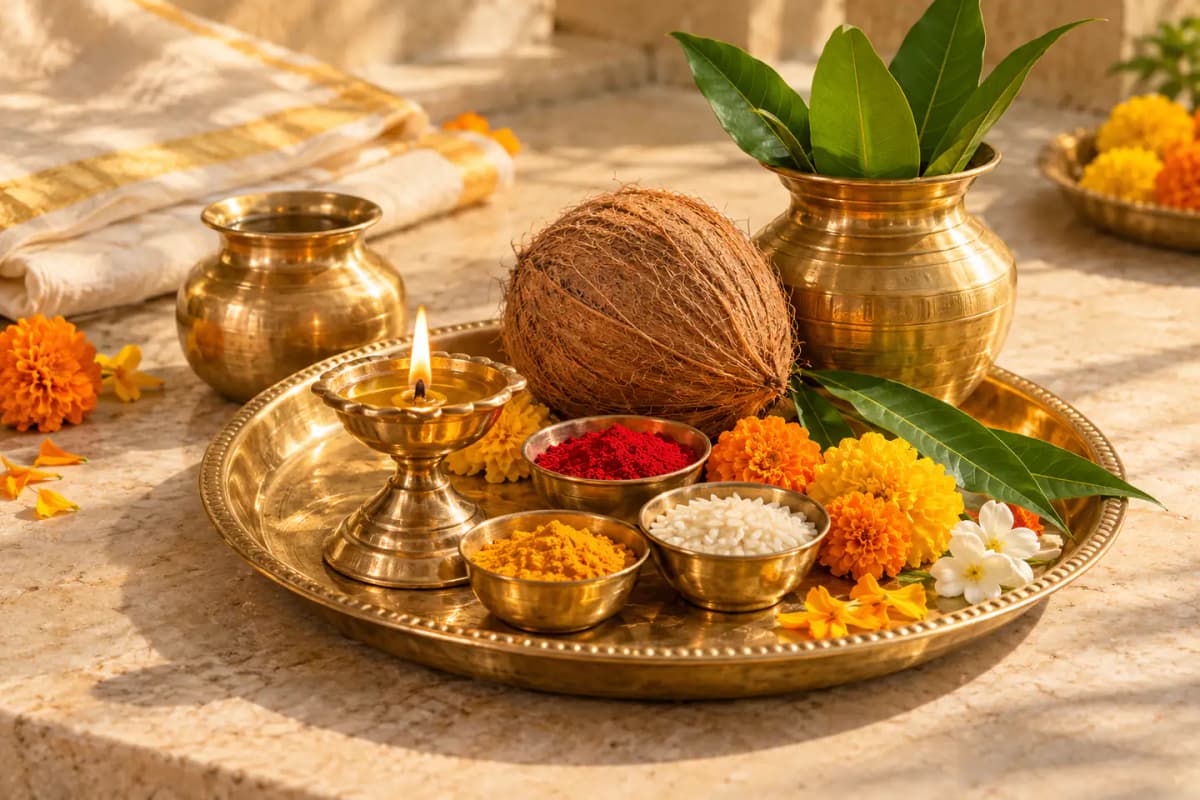
On a festival morning, devotees bathe early, clean and decorate the home mandir with a Mango-leaf Toran and Rangoli, light a ghee lamp, take Sankalpa, invoke Lord Ganesha first, offer Shodashopachara or Panchopachara puja and traditional festival Naivedya to the presiding deity, recite the festival Vrat Katha, and conclude with Aarti and Prasad distribution.