

Shri Ramcharitmanas (Ramayana) — All 7 Kands
Sacred verses of Goswami Tulsidas’s Shri Ramcharitmanas across all 7 Kands — from Bala Kand & Sundar Kand to Uttar Kand with interactive shloka meanings, Devanagari / Roman (IAST) script toggle, and dual printable PDFs.
The Seven Kands / Sopans (Key Points)
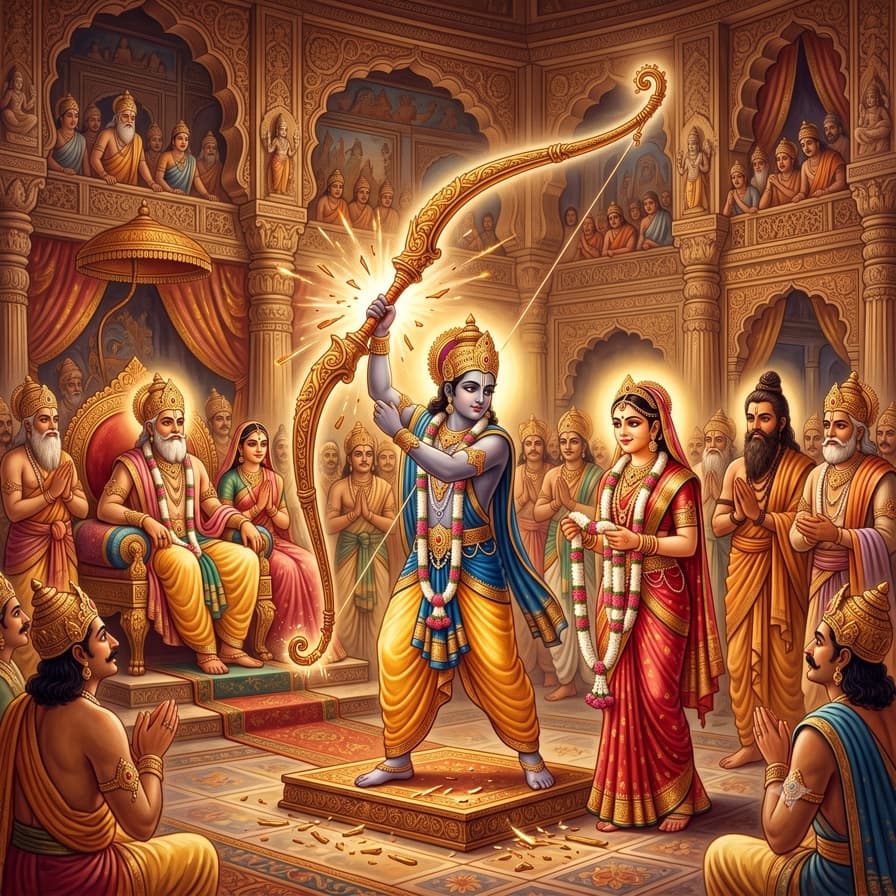
- Bala & Ayodhya Kand: Divine birth of Lord Rama, Sita Swayamvar, 14-year forest exile, and Bharata’s devotion at Chitrakoot.
- Aranya, Kishkindha & Sundar Kand: Shabari’s bhakti, alliance with Hanuman & Sugriva, and Hanuman’s leap across the ocean to Lanka.
- Lanka & Uttar Kand: Setu Bandhan, victory over Ravana, coronation of Rama Rajya, and eternal bhakti teachings.
All 7 Kands of Shri Ramcharitmanas (complete list)
Frequently Asked Questions
What is the difference between Maharshi Valmiki’s Ramayana and Goswami Tulsidas’s Shri Ramcharitmanas?
Maharshi Valmiki composed the Adi-Kavya Ramayana in classical Sanskrit (24,000 Anushtubh shlokas), while Goswami Tulsidas composed the Shri Ramcharitmanas in 16th-century Awadhi using the Doha–Chaupai meter, presenting Lord Shri Rama as the Supreme Parabrahman through Prema-Bhakti.
When and where did Goswami Tulsidas compose the Shri Ramcharitmanas?
Goswami Tulsidas began composing the Shri Ramcharitmanas in Ayodhya on Ram Navami (Chaitra Shukla Navami, Vikram Samvat 1631 / 1574 CE) and completed its seven Kands over two years, seven months, and twenty-six days across Ayodhya, Chitrakoot, and Kashi (Varanasi).
How are Doha, Chaupai, Soratha, and Chhand verses structured in the Ramcharitmanas?
The Ramcharitmanas alternates groups of four-line narrative quatrains (Chaupais, 16 matras per quarter) with two-line rhyming couplets (Dohas, 13+11 matras; or inverted Sorathas, 11+13 matras) and musical Sanskrit/Awadhi Chhands (such as Harigitika and Tribhangi) at moments of intense devotion.
What are the four narrator dialogues (Chari Ghaat / Four Samvads) of the Manas Sarovar?
Tulsidas compares the Ramcharitmanas to the sacred Manas Lake framed by four ghats (dialogues): 1. Lord Shiva and Goddess Parvati (Jnana Ghat), 2. Sage Kakabhushundi and Garuda (Upasana/Bhakti Ghat), 3. Sage Yajnavalkya and Sage Bharadwaja (Karma Ghat), and 4. Goswami Tulsidas and the assembly of saints (Dainya/Prapatti Ghat).
How is a 24-hour Akhand Ramayan Path or 9-day Navah Parayan performed?
An Akhand Path is an unbroken 24-hour continuous recitation of all seven Kands before a lit Akhand Jyoti and Kalash, whereas a Navah Parayan divides the entire text into nine equal daily portions (Vishrams) completed over nine days (especially during Chaitra and Shardiya Navratri).
Why is Sundar Kand often recited as an independent Path on Tuesdays and Saturdays?
Unlike the other six Kands centered on Lord Rama’s chronological biography, Sundar Kand celebrates the devotion, courage, and triumph of Sevak Hanuman Ji — crossing the ocean, comforting Mata Sita in Ashok Vatika, and bringing Vibhishana to Lord Rama’s shelter.