

Aranya Kand
Sacred forest life at Panchavati, encounters with sages, Ravana’s abduction of Sita, Jatayu’s supreme sacrifice, and Mother Shabari’s loving devotion
Frequently Asked Questions
What major events (kathas) are narrated in the Aranya Kand of Shri Ramcharitmanas?
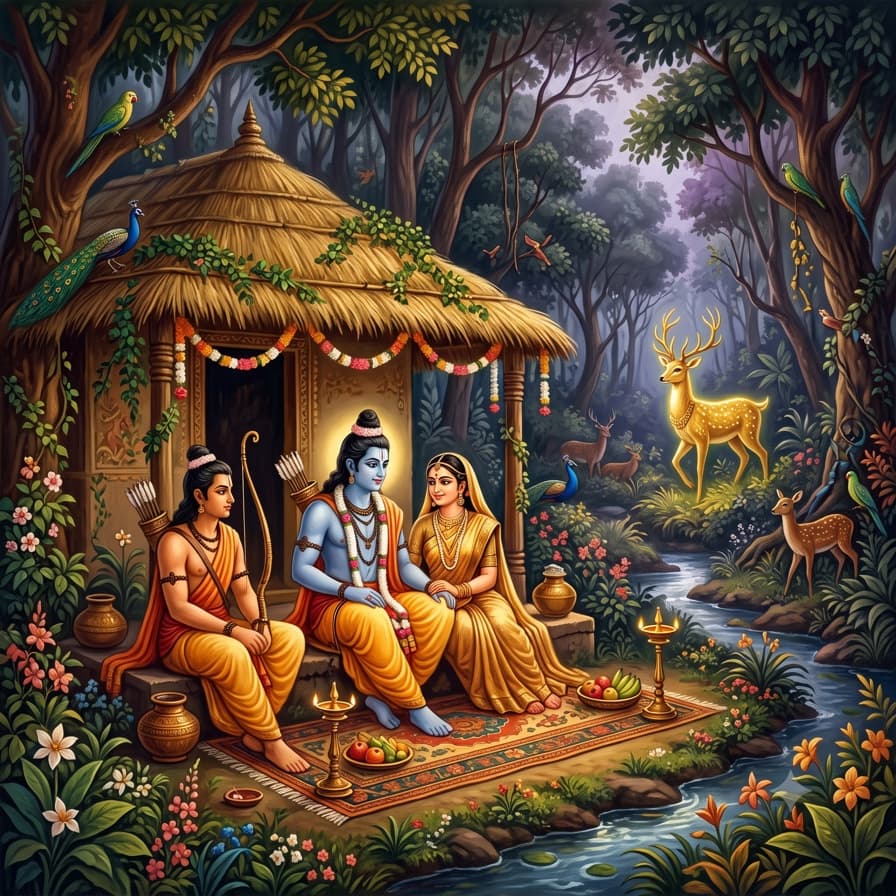
The Aranya Kand (अरण्यकाण्ड) of Goswami Tulsidas’s Ramcharitmanas narrates Lord Rama’s forest sojourn in Dandakaranya and Panchavati — meetings with Sages Atri-Anasuya, Sharabhanga, Sutikshna, and Agastya; Lakshmana’s Upadesh on Maya and Bhakti; Jatayu’s supreme sacrifice; and Mata Shabari’s Navadha Bhakti.
What does the opening Sanskrit Mangalacharan of Aranya Kand invoke?
Aranya Kand opens with "Moolam dharmataror viveka-jaladheh purnendum anandadam..." extolling Lord Rama as the root of the tree of Dharma, the full moon to the ocean of discrimination (Viveka), and the dispeller of the dense darkness of delusion.
Which are the most celebrated dialogues and turning points in Aranya Kand?
Key teachings include Anasuya’s discourse to Sita on Pativrata Dharma, Lord Rama’s Panchavati discourse to Lakshmana on Ishwara, Jiva, Maya, and Bhakti (Dohas 14–16), Jatayu resting in Lord Rama’s lap, and the nine limbs of Navadha Bhakti taught to Shabari (Dohas 34–36).
What is the central spiritual teaching and parayan significance of Aranya Kand?
Across 46 Dohas, Aranya Kand teaches that birth, lineage, or scholarship cannot win the Lord — as declared to Shabari ("Kahahu bhagati patha kavana prayasa... Bhamini bhagati mora ati pyara"), only sincere devotion (Bhakti-sambandha) pleases Him.