

Lanka Kand
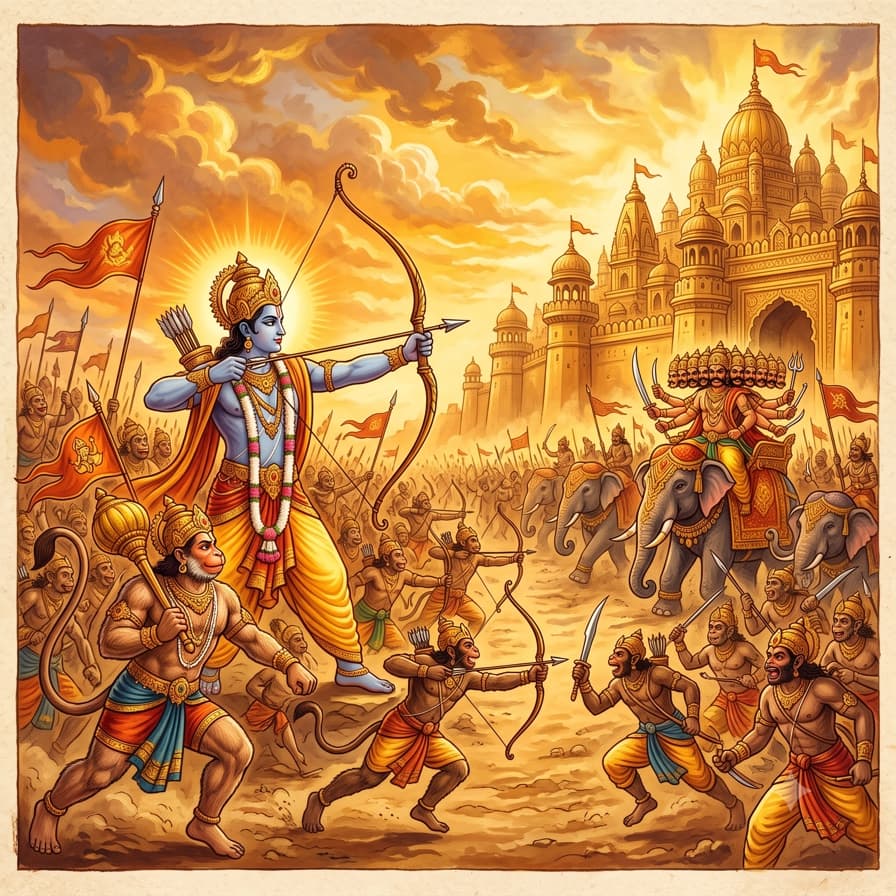
Vibhishana’s surrender, Setu Bandhan across the ocean, epic battle of Lanka, slaying of Kumbhakarna, Meghnad and Ravana, and Sita’s reunion with Lord Rama
Frequently Asked Questions
What major events (kathas) are narrated in the Lanka Kand of Shri Ramcharitmanas?
The Lanka Kand (लंकाकाण्ड) of Goswami Tulsidas’s Ramcharitmanas narrates the construction of the Nala-Nila Rama Setu across the ocean, Lord Rama establishing Rameshwaram Shiva Linga, Angada’s unshakeable embassy in Ravana’s court, Hanuman bringing the Sanjivani mountain for Lakshmana, the slaying of Kumbhakarna, Meghnada, and Ravana, and Sita’s Agni-Pravesh.
What does the opening Sanskrit Mangalacharan of Lanka Kand invoke?
Lanka Kand opens with "Ramam kamari-sevyam bhavabhaya-haranam kalamattadvipendram..." praising Lord Rama who is worshipped by Shiva (destroyer of Kama), who removes the fear of worldly existence, and who is like a lion to the elephant of Death.
Which are the most celebrated dialogues and turning points in Lanka Kand?
Pivotal scenes include Lord Rama declaring the glory of Rameshwaram Shiva ("Shiva drohi mama bhagata kahava, so nara sapaneahun mohi na pava"), the Dharma-Ratha teaching given to Vibhishana (Doha 79 — describing the spiritual chariot of victory), and the final liberation of Ravana.
What is the central spiritual teaching and parayan significance of Lanka Kand?
Across 121 Dohas, Lanka Kand’s crown jewel is the Dharma-Ratha teaching (Doha 79): true victory in life’s inner and outer battles is won not merely by weapons, but by the chariot whose wheels are courage and patience, whose banner is truth and character, and whose horses are strength, discretion, self-control, and benevolence.