

Uttar Kand
Triumphant return to Ayodhya, coronation of Lord Rama (Rama Rajya), Kakbhushundi–Garuda spiritual discourse, and eternal bhakti teachings of Goswami Tulsidas
Frequently Asked Questions
What major events (kathas) are narrated in the Uttar Kand of Shri Ramcharitmanas?
The Uttar Kand (उत्तरकाण्ड) of Goswami Tulsidas’s Ramcharitmanas narrates Lord Rama's triumphant return to Ayodhya on the Pushpaka Vimana, the joyous reunion with Bharata, the Vedic Rajyabhisheka and ideal governance of Rama Rajya, Shiva narrating the Kakabhushundi–Garuda dialogue on Bhakti vs. Jnana, and the concluding Ramcharitmanas Mahatmya.
What does the opening Sanskrit Mangalacharan of Uttar Kand invoke?
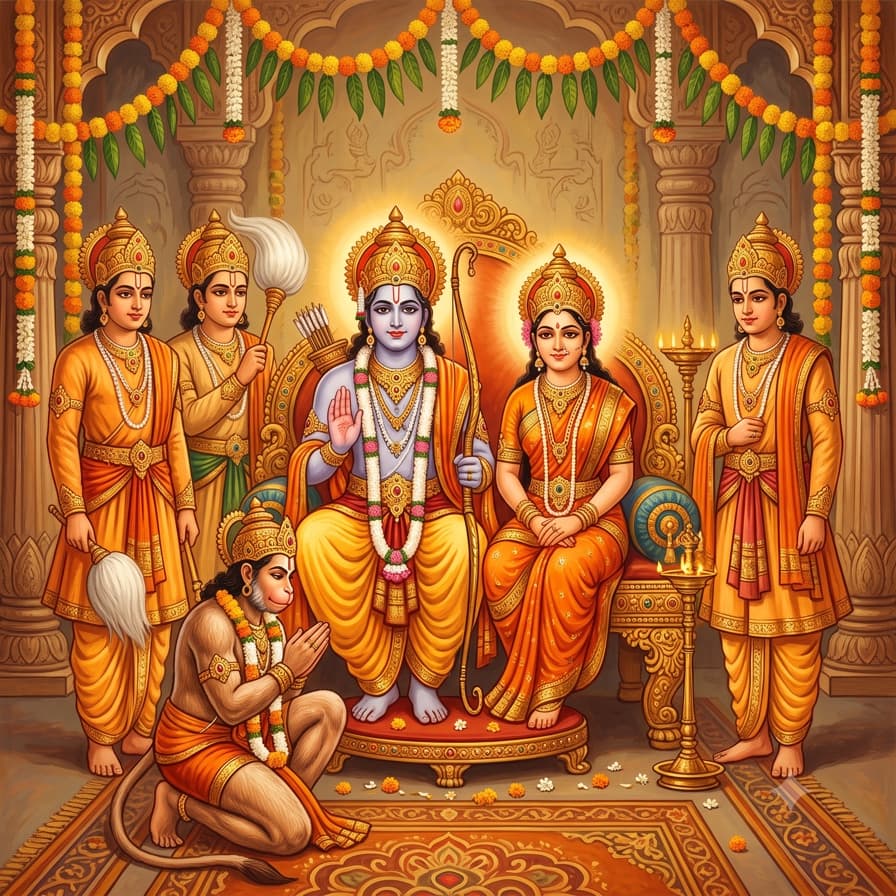
Uttar Kand opens with "Keki-kanthabha-nilam suravara-vilasad-vipra-padabja-chihnam..." meditating upon Lord Rama whose complexion gleams blue like a peacock’s neck, whose chest bears the Bhrigu-lotus-foot mark, and who sits enthroned in Ayodhya alongside Mata Sita and attended by Lakshmana, Bharata, Shatrughna, and Hanuman.
Which are the most celebrated dialogues and turning points in Uttar Kand?
Foundational discourses include the description of Rama Rajya ("Daihika daivika bhautika tapa, Rama raja nahin kahuhipi vyapa", Doha 20), Lord Rama teaching the citizens of Ayodhya that human birth and satsang are the greatest blessings (Doha 42–45), and the Kakabhushundi–Garuda dialogue on the supremacy of Bhakti Mani over Jnana Dipaka (Doha 118–121).
What is the central spiritual teaching and parayan significance of Uttar Kand?
In 130 Dohas, Uttar Kand crowns the entire Ramcharitmanas: while Jnana is a fragile oil lamp that winds of Maya can extinguish, Prema-Bhakti is a self-luminous divine gem (Chintamani) in whose light ignorance and sorrow vanish effortlessly.