

Kishkindha Kand
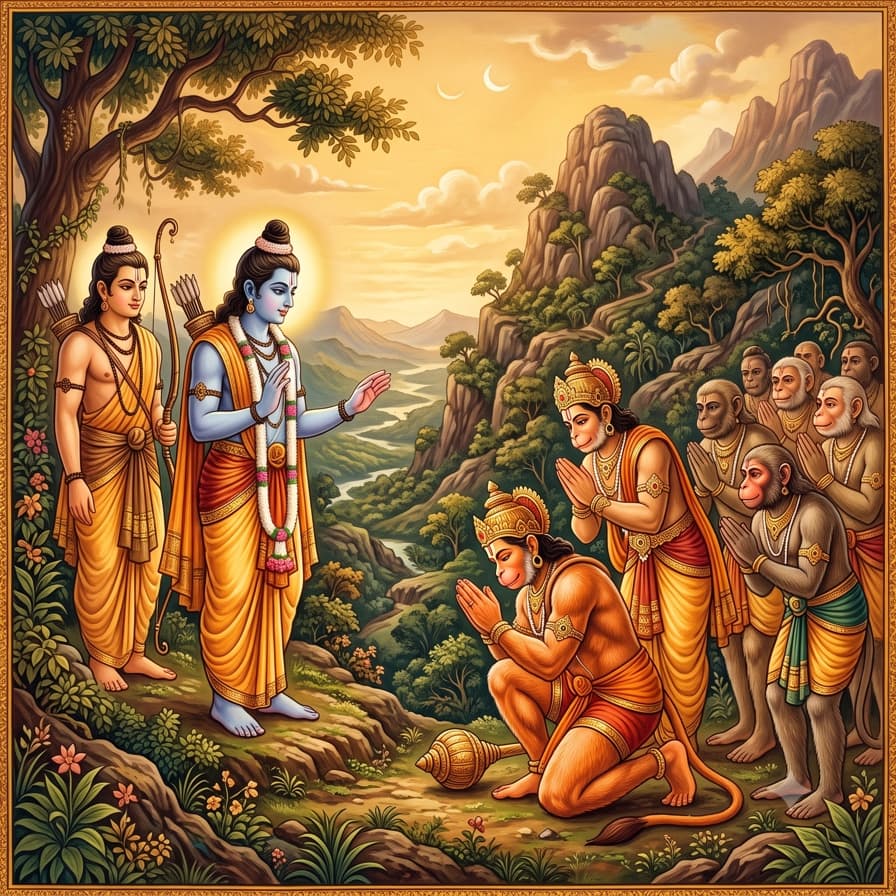
First meeting of Lord Rama and Hanuman, sacred friendship with Sugriva, slaying of Vali, and Jambavan awakening Hanuman’s boundless strength to find Sita
Frequently Asked Questions
What major events (kathas) are narrated in the Kishkindha Kand of Shri Ramcharitmanas?
The Kishkindha Kand (किष्किन्धाकाण्ड) of Goswami Tulsidas’s Ramcharitmanas narrates Hanuman Ji's first meeting with Lord Rama at Rishyamukha mountain, the sacred friendship between Rama and Sugriva before the fire, the liberation of Vali, the Varsha & Sharad Ritu spiritual allegories, and Jambavan awakening Hanuman's boundless strength at the southern ocean.
What does the opening Sanskrit Mangalacharan of Kishkindha Kand invoke?
Kishkindha Kand opens with "Kundendivara-sundaram अतिबलं विज्ञानधामामरं..." bowing to Lord Rama (fair as the blue lotus) and Lakshmana (fair as the jasmine and moon), along with Hanuman Ji who delights in the nectar of Rama’s lotus feet.
Which are the most celebrated dialogues and turning points in Kishkindha Kand?
Highlights include Lord Rama embracing Hanuman ("Sunu kapi jiya manahu jani una, tumha te priya mohi bharata na duna"), the six marks of a true friend (Chaupai 6), Sampati guiding the Vanaras toward Lanka, and Jambavan’s call to Hanuman ("Kavan so kaja kathina jaga mahi, jo nahi hoi tata tumha pahi").
What is the central spiritual teaching and parayan significance of Kishkindha Kand?
In 30 compact Dohas, Kishkindha Kand represents Satsanga and Guru-kripa — showing how a true messenger (Hanuman) unites the individual soul (Sugriva) with the Supreme Lord (Rama) and how dormant spiritual potential awakens when reminded by a wise elder (Jambavan).