The Adi Kavya by Valmiki | ~24,000 Shlokas (traditional count) | The Divine Story of Maryada Purushottama
को न्वस्मिन् साम्प्रतं लोके गुणवान् कश्च वीर्यवान् ।
धर्मज्ञश्च कृतज्ञश्च सत्यवाक्यो दृढव्रतः ॥
Valmiki Ramayana 1.1.2 (Bala Kanda)
"Who in this world today is truly virtuous, valiant, righteous, grateful, and truthful?" — Maharishi Valmiki's question to Narada, answered by one name: Rama.
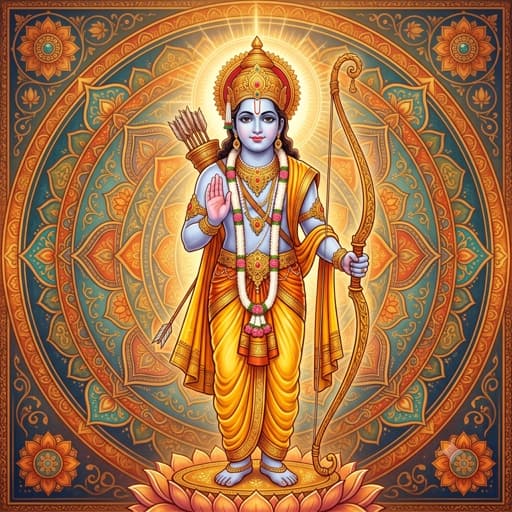
The Valmiki Ramayana — the Adi Kavya (first poem) of Sanskrit literature — tells the divine story of Lord Rama across 24,000 shlokas and 7 Kandas. Composed by the sage Valmiki, it is the supreme embodiment of Maryada (righteous conduct), Bhakti (devotion), Tyaga (renunciation), and Dharma. Rama is not merely a king — he is the Maryada Purushottama: the ideal son, husband, ruler, and friend.
Birth and childhood of Rama in Ayodhya. King Dasharatha's yajna (fire ritual) for a son, the birth of Rama, Lakshmana, Bharata, and Shatrughna. Sage Vishwamitra takes Rama and Lakshmana to protect his ashram from demons. Rama slays Tataka and frees Ahalya. The Swayamvara of Sita — Rama lifts and strings the divine bow of Shiva, winning Sita's hand in marriage.
Significance: Establishes the ideal of Ayodhya as Rama Rajya; introduces Sita-Rama as the divine couple embodying Dharma.
Rama is about to be crowned king when Queen Kaikeyi demands two boons from Dasharatha: Bharata's coronation and Rama's 14-year exile. Rama accepts without protest, embodying Maryada (righteous conduct). Sita and Lakshmana insist on accompanying him. The heartbroken Dasharatha dies of grief. Bharata refuses the throne and places Rama's sandals as regent, awaiting his return.
Significance: The pinnacle of Maryada — Rama's selfless acceptance of exile defines ideal conduct for son, husband, and prince.
Rama, Sita, and Lakshmana live in Dandakaranya forest. Rama fulfils his promise to the sages — freeing their ashrams from demonic harassment. Surpanakha (Ravana's sister) is disfigured after her advances are rejected. Ravana, incited by her, sends Maricha as a golden deer to lure Rama away. In Rama's absence, Ravana abducts Sita. The vulture Jatayu dies valiantly attempting to rescue her.
Significance: The abduction of Sita — Dharma violated; establishes the central conflict of the entire epic.
Rama and Lakshmana meet Hanuman, sent by the Vanara king Sugriva. Rama kills Vali (Sugriva's usurper brother) and installs Sugriva as king. In gratitude, Sugriva marshals the great Vanara army to search for Sita across all four directions. Hanuman's group heads south, discovers that Sita is held in Lanka, and Hanuman leaps across the ocean.
Significance: The divine alliance — Rama and Hanuman; the unbreakable bond of Bhakti and Grace.
Hanuman leaps across the ocean to Lanka — one of the most celebrated feats in the epic. He locates Sita in the Ashoka Vatika garden, delivers Rama's message, destroys the garden, allows himself to be captured, meets Ravana, and sets Lanka ablaze with his burning tail before returning victorious. The Sundara Kanda is recited independently as it contains the concentrated essence of Bhakti.
Significance: Pure Bhakti in action — Hanuman as the ideal devotee; his Ashoka Vatika monologue is among the greatest devotional passages in Sanskrit literature.
The great war — Rama builds a bridge (Rama Setu) to Lanka with the Vanara army. Vibhishana, Ravana's righteous brother, joins Rama. The epic battle unfolds: Kumbhakarna, Indrajit (Meghanada), and finally Ravana himself are slain by Rama. Sita passes through the Agni Pariksha (fire ordeal) to prove her purity. Vibhishana is crowned the righteous king of Lanka, and Rama — with Sita and Lakshmana — returns to Ayodhya in the Pushpaka Vimana, beginning Rama Rajya.
Significance: The triumph of Dharma over Adharma — and Vibhishana's surrender (Sharanagati) as the model of righteous surrender to God.
Rama rules Ayodhya in the golden age of Rama Rajya. Due to a washerman's comment about Sita's purity after Lanka captivity, Rama sends the pregnant Sita to the forest — one of the most debated episodes in the epic. Sita finds refuge with Valmiki, gives birth to Lava and Kusha. The twins sing the Ramayana before Rama and are recognised. Sita prays to the Earth (her mother) and is received. Rama returns to his divine abode (Vaikuntha) as time passes.
Significance: Rama Rajya — the ideal governance; the tragic humanity of Dharma; Lava and Kusha as the first reciters of the Ramayana.
Key Characters
Rama
Maryada Purushottama — the ideal son, husband, king, and friend
Sita
Embodiment of grace, steadfastness, and feminine divinity (Shakti)
Lakshmana
Ideal younger brother — unfailing loyalty and selfless service
Hanuman
Supreme devotee (Bhakta) — strength, wisdom, and total surrender to Rama
Ravana
Learnèd but ego-bound — the danger of intellect without Dharma
Vibhishana
Righteous surrender (Sharanagati) — even from Ravana's own kin
Key Shlokas
Valmiki Ramayana 1.1.2 (Bala Kanda)Valmiki's Question to Narada — The Ideal Man
को न्वस्मिन् साम्प्रतं लोके गुणवान् कश्च वीर्यवान् ।
धर्मज्ञश्च कृतज्ञश्च सत्यवाक्यो दृढव्रतः ॥
Ko nv asmin sāmprataṁ loke guṇavān kaś ca vīryavān |
Dharma-jñaś ca kṛtajñaś ca satya-vākyo dṛḍha-vrataḥ ||
Who in this world today is possessed of all virtues, who is mighty, who knows what is right, who is grateful, who is truthful, and who is firm in his vows?
Sundara Kanda 36.2Hanuman's Declaration to Sita
वानरोऽहं महाभागे दूतो रामस्य धीमतः ।
रामनामाङ्कितं चेदं पश्य देव्यङ्गुलीयकम् ॥
Vānaro'haṁ mahā-bhāge dūto rāmasya dhīmataḥ |
Rāma-nāmāṅkitaṁ cedaṁ paśya devy aṅgulīyakam ||
O noble lady, I am a vanara — the messenger of the wise Rama. Behold, O Devi, this ring engraved with Rama's own name.
Yuddha Kanda 18.33 — Rama to VibhishanaThe Promise of Refuge (Sharanagati)
सकृदेव प्रपन्नाय तवास्मीति च याचते ।
अभयं सर्वभूतेभ्यो ददाम्येतद् व्रतं मम ॥
Sakṛd eva prapannāya tavāsmīti ca yācate |
Abhayaṁ sarva-bhūtebhyo dadāmy etad vrataṁ mama ||
To one who surrenders to Me even once, saying "I am yours" — to all such beings I grant fearlessness. This is my vow.
Core Teachings of the Ramayana
Maryada — uphold the righteous code in personal, family, and social life
Bhakti — Hanuman exemplifies complete surrender combined with devoted service
Tyaga — Rama, Sita, and Lakshmana accepted exile willingly for Dharma
Sharanagati — Vibhishana's refuge-seeking: total surrender to the Divine
Rama Rajya — ideal governance grounded in justice, love, and Dharma
How many Kandas (books) are there in the Valmiki Ramayana?
The Valmiki Ramayana has 7 Kandas (books): Bala Kanda, Ayodhya Kanda, Aranya Kanda, Kishkindha Kanda, Sundara Kanda, Yuddha Kanda (also called Lanka Kanda), and Uttara Kanda — together comprising about 24,000 shlokas (verses).
Who wrote the Ramayana and why is it called the Adi Kavya?
The Ramayana was composed by Maharishi Valmiki. It is called the Adi Kavya — the "first poem" — because it is traditionally regarded as the earliest formal epic poem (mahakavya) of Sanskrit literature, the source-form from which later poetry developed.
Why is Rama called Maryada Purushottama?
Rama is called Maryada Purushottama — the "ideal man who upholds righteous limits" — because he perfectly fulfils dharma in every role: as an obedient son, a devoted husband, a just king, and a loyal friend, never crossing the bounds of righteous conduct even at great personal cost.
Why is the Sundara Kanda recited on its own?
The Sundara Kanda narrates Hanuman's leap to Lanka, his finding of Sita, and his return — a self-contained story of courage, devotion (bhakti), and hope. Devotees recite it independently, especially on Tuesdays and Saturdays, as it is considered the most auspicious and uplifting Kanda of the epic.
What is the difference between Valmiki Ramayana and Tulsidas Ramcharitmanas?
The Valmiki Ramayana is the original Sanskrit epic in 7 Kandas (~24,000 shlokas). The Ramcharitmanas, composed by Goswami Tulsidas in Awadhi, is a later devotional retelling in 7 Kands that focuses on bhakti towards Rama. This page summarises the Valmiki Ramayana; both share the same story arc.
What are the core teachings of the Ramayana?
The Ramayana teaches Maryada (righteous conduct), Bhakti (devotion, exemplified by Hanuman), Tyaga (selfless renunciation), Sharanagati (surrender to the Divine, shown by Vibhishana), and the ideal of Rama Rajya — governance rooted in justice, truth, and compassion.
Continue Your Spiritual Journey
Explore related Hindu wisdom, daily guidance, and AI-powered answers on VedKosh.