

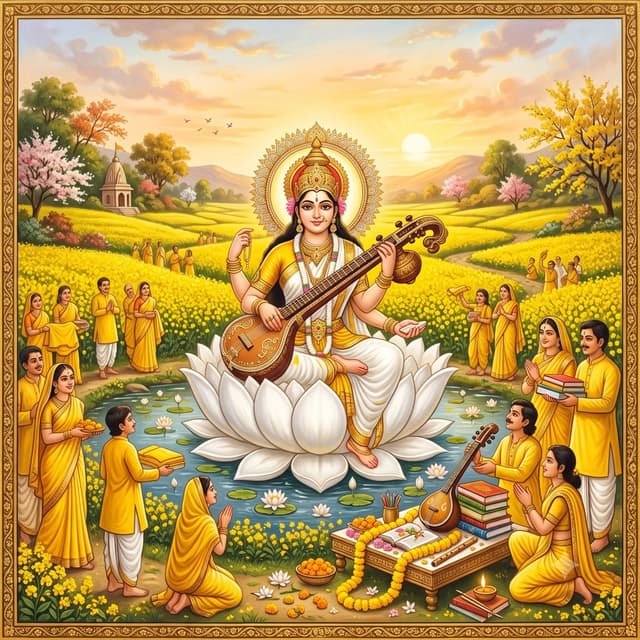
Vasant Panchami — Saraswati Puja & Arrival of Spring
23 January 2026 · Friday
Tithi
Magha Shukla Panchami
Auspicious Muhurat · IST
Pujan Muhurat: 7:12 AM – 12:35 PM IST (Brahma + Madhyahna)
Tithi Duration…
Abhijit Muhurat…
Sunrise / Sunset…
Source: Vedic Panchang, IST
All timings shown for:…
Festival dates follow the India (IST) Vedic calendar.
Quick Info
Saraswati Puja — worship of the Goddess of knowledge, music, and arts. Wear yellow, bless new books.
सरस्वती पूजा — विद्या, संगीत और कला की देवी की आराधना। पीला पहनें, नई किताबें स्पर्श करें।
About this festival
Vasant Panchami (23 Jan 2026) is celebrated on Magha Shukla Panchami — the day Goddess Saraswati emerged from the mouth of Lord Brahma per the Brahmavaivarta Purana. It also marks the formal arrival of Vasant (spring) ritu. Yellow is the day's colour. Schools, students, and musicians worship Saraswati; many initiate children's first lessons (Akshar Abhyasam / Vidyarambham) on this auspicious day.
वसंत पंचमी (23 जनवरी 2026) माघ शुक्ल पंचमी को मनाई जाती है — ब्रह्मवैवर्त पुराण के अनुसार इसी दिन भगवान ब्रह्मा के मुख से देवी सरस्वती प्रकट हुईं। यह वसंत ऋतु के औपचारिक आगमन का भी दिन है। दिवस का रंग पीला। विद्यालय, विद्यार्थी और संगीतकार सरस्वती की पूजा करते हैं; कई परिवार इसी शुभ दिन बच्चों का पहला अक्षर लेखन (अक्षर अभ्यासम् / विद्यारम्भम्) कराते हैं।
Vasant Panchami 2026 outside India — local timings for USA, UK, Canada, Australia, Singapore & UAEवसंत पंचमी 2026 भारत के बाहर — अमेरिका, ब्रिटेन, कनाडा, ऑस्ट्रेलिया, सिंगापुर और यूएई में स्थानीय समय
A tithi begins and ends at the same instant everywhere on Earth — only your local clock reading differs. That is why the same tithi can fall on the previous or the next calendar day where you live, even though the festival date on this page follows the Vedic Panchang, IST.
Classical observance windows — sunrise, midday, afternoon, evening and midnight — are defined by your own sunrise and sunset, not by India's. The table below gives those local values for the major diaspora cities.
तिथि पृथ्वी पर हर स्थान पर एक ही क्षण आरम्भ और समाप्त होती है — केवल आपकी स्थानीय घड़ी का समय भिन्न होता है। इसीलिए वही तिथि आपके यहाँ पिछले या अगले कैलेंडर दिन पड़ सकती है, जबकि इस पृष्ठ की तिथि वैदिक पंचांग (IST) के अनुसार है।
सूर्योदय, मध्याह्न, अपराह्न, प्रदोष और निशीथ जैसे शास्त्रीय काल आपके अपने सूर्योदय-सूर्यास्त से निर्धारित होते हैं, भारत के नहीं। नीचे प्रमुख प्रवासी नगरों के स्थानीय मान दिए गए हैं।
| City | Sunrise | Sunset | Shukla Panchami (local time) |
|---|---|---|---|
| Ujjain, India | 7:09 AM | 6:07 PM | Jan 23, 2:29 AM → Jan 24, 1:46 AM |
| New York, USA | 7:13 AM | 5:02 PM | Jan 22, 3:59 PM → Jan 23, 3:16 PM |
| Chicago, USA | 7:10 AM | 4:54 PM | Jan 22, 2:59 PM → Jan 23, 2:16 PM |
| San Jose (Bay Area), USA | 7:16 AM | 5:22 PM | Jan 22, 12:59 PM → Jan 23, 12:16 PM |
| Toronto, Canada | 7:42 AM | 5:16 PM | Jan 22, 3:59 PM → Jan 23, 3:16 PM |
| London, UK | 7:51 AM | 4:33 PM | Jan 22, 8:59 PM → Jan 23, 8:16 PM |
| Dubai, UAE | 7:04 AM | 5:56 PM | Jan 23, 12:59 AM → Jan 24, 12:16 AM |
| Singapore | 7:14 AM | 7:18 PM | Jan 23, 4:59 AM → Jan 24, 4:16 AM |
| Sydney, Australia | 6:07 AM | 8:06 PM | Jan 23, 7:59 AM → Jan 24, 7:16 AM |
Overseas communities differ: some follow the India Panchang date, others observe on the local day the tithi prevails. Confirm the observance day with your local temple or community.
विदेश में समुदायों की परम्परा भिन्न है: कुछ भारत के पंचांग की तिथि मानते हैं, कुछ उस स्थानीय दिन पर व्रत रखते हैं जब तिथि व्याप्त हो। अपने स्थानीय मन्दिर या समुदाय से व्रत का दिन अवश्य सुनिश्चित करें।
Quick Facts
- Date 2026: 23 Jan (Magha Shukla Panchami)
- Patron deity: Goddess Saraswati (consort of Brahma, source of all learning)
- Colour of the day: Yellow (saffron-yellow, jonquil)
- Best practice: Vidyarambham — first letter-tracing for children
- Scriptural origin: Brahmavaivarta Purana, Prakriti Khanda, Chapter 4
Vasant Panchami Pujan Vidhiवसंत पंचमी पूजन विधि
- Bathe before sunrise; wear new yellow cotton (saari, kurta, or salwar)
- Clean the puja altar; place a chowki facing east; spread yellow cloth
- Set up Saraswati pratima/photo; place books, pens, harmonium/musical instruments, and any tools-of-craft for blessing
- Offer 5 yellow flowers (marigold, mustard), 5 yellow fruits (banana, lemon), yellow sweets (boondi, kesari halwa), milk, akshat
- Light a ghee-lamp + dhup (chandan); offer a yellow-thread janeyu around the murti
- Sankalp + recite Saraswati Vandana 'Ya Kundendu Tushara Hara Dhavala...' (Saraswati Stotram)
- Chant 'Om Aim Saraswatyai Namah' (Saraswati Beej Mantra) 108 times with a sphatika (crystal) or rudraksha mala
- Vidyarambham: place a child's finger on rice grains; trace 'Om' first, then alphabet letters (Hindi/regional script)
- Eat one yellow-only prasad meal: kesari rice, boondi laddoo, jaggery-til chikki
- सूर्योदय से पहले स्नान; नया पीला सूती वस्त्र (साड़ी, कुर्ता या सलवार)
- पूजा वेदी शुद्ध करें; पूर्व मुख चौकी; पीला वस्त्र बिछाएँ
- सरस्वती प्रतिमा/चित्र; पुस्तकें, कलम, हारमोनियम/वाद्य, अपने काम के औजार आशीर्वाद हेतु रखें
- 5 पीले फूल (गेंदा, सरसों), 5 पीले फल (केला, नींबू), पीली मिठाई (बूँदी, केसरी हलवा), दूध, अक्षत अर्पण
- घी का दीप + धूप (चंदन); मूर्ति के चारों ओर पीला यज्ञोपवीत बाँधें
- संकल्प + सरस्वती वंदना 'या कुन्देन्दु तुषार हार धवला...' (सरस्वती स्तोत्रम्)
- स्फटिक (क्रिस्टल) या रुद्राक्ष माला से 'ॐ ऐं सरस्वत्यै नमः' (सरस्वती बीज) 108 बार
- विद्यारम्भम्: बच्चे की उँगली चावल पर रखें; पहले 'ॐ', फिर वर्णमाला अक्षर (हिंदी/क्षेत्रीय लिपि)
- केवल पीला प्रसाद भोजन: केसरी चावल, बूँदी लड्डू, गुड़-तिल चिक्की
Do's
- Wear yellow — head to toe; even yellow turmeric tilak
- Place ALL books, instruments, and tools-of-craft before Saraswati for blessing — keep them un-used through the day
- Initiate children's writing/learning today (Vidyarambham)
- Listen to or perform classical music — Saraswati is the patroness of all sangeet
Don'ts
- Do not read or write before sunrise pujan — books are at Saraswati's feet
- Avoid black or red on this day — yellow only
- Do not throw away or step on books for the entire week — Saraswati's apriya
- Do not consume non-veg, alcohol — sattvic day
क्या करें
- पीला पहनें — सिर से पैर तक; पीली हल्दी का तिलक भी
- सभी पुस्तकें, वाद्य, और औजार आशीर्वाद हेतु सरस्वती के समक्ष रखें — दिनभर अप्रयुक्त
- बच्चों की लेखन/शिक्षा आज से प्रारम्भ करें (विद्यारम्भम्)
- शास्त्रीय संगीत सुनें या प्रस्तुत करें — सरस्वती समस्त संगीत की अधिष्ठात्री
क्या न करें
- सूर्योदय पूजन से पहले न पढ़ें-न लिखें — पुस्तकें सरस्वती के चरणों में हैं
- इस दिन काला या लाल वर्जित — केवल पीला
- पूरे सप्ताह पुस्तकें न फेंकें न पैर लगाएँ — सरस्वती-अप्रिय
- मांसाहार, मद्य वर्जित — सात्विक दिवस
Mantrasमंत्र
ॐ ऐं सरस्वत्यै नमः ॥
Om Aiṁ Sarasvatyai Namaḥ
Salutations to Goddess Saraswati — the Saraswati Beej Mantra. (Saraswati Tantra)
देवी सरस्वती को नमन — सरस्वती बीज मंत्र। (सरस्वती तंत्र)
↻ 108 times on Magha Shukla Panchami
या कुन्देन्दु तुषार हार धवला या शुभ्र वस्त्रावृता । या वीणावरदण्डमण्डितकरा या श्वेतपद्मासना ॥
Yā Kundendu Tuṣāra Hāra Dhavalā Yā Śubhra Vastrāvṛtā, Yā Vīṇā-vara-daṇḍa-maṇḍita-karā Yā Śveta-padmāsanā
She who is white as jasmine, moon, snow, and a pearl-string; clad in pure white; her hands adorned with veena and the boon-staff; seated on a white lotus — to her I bow. (Saraswati Stotram by Adi Shankaracharya / Agastya, Verse 1)
जो कुन्द-पुष्प, चन्द्र, हिम-हार के समान श्वेत हैं; श्वेत वस्त्र पहने हैं; जिनके हाथ वीणा और वर-दण्ड से सुशोभित हैं; जो श्वेत पद्म पर विराजमान हैं — उन्हें प्रणाम। (सरस्वती स्तोत्रम् आदि शंकराचार्य / अगस्त्य, श्लोक 1)
↻ 11 or 21 times
Saraswati's Emergence — Brahmavaivarta Puranaसरस्वती का प्राकट्य — ब्रह्मवैवर्त पुराण
Per Brahmavaivarta Purana (Prakriti Khanda, Ch 4), Brahma created the universe but felt it was incomplete — formless, soundless, voiceless. He prayed to Lord Krishna, who manifested as Saraswati from Brahma's mouth on Magha Shukla Panchami — clothed in white, holding a veena, a book, japa-mala, and lotus.
From her veena emerged the seven swaras (musical notes); from her book emerged the Vedas; from her speech emerged Sanskrit and all languages; from her mala emerged sustained sadhana. She thus is the personification of vidya (knowledge), kala (arts), sangeet (music), and vak (speech). Yellow is her colour because Vasant ritu's mustard fields turn yellow at this time — a natural celebration of the goddess of light-and-learning.
ब्रह्मवैवर्त पुराण (प्रकृति खंड, अध्याय 4) के अनुसार ब्रह्मा ने सृष्टि की किंतु वह अधूरी प्रतीत हुई — निराकार, निःशब्द, निर्वाक्। उन्होंने भगवान कृष्ण से प्रार्थना की, जो माघ शुक्ल पंचमी को ब्रह्मा के मुख से सरस्वती के रूप में प्रकट हुए — श्वेत वस्त्र, वीणा, पुस्तक, जप-माला और कमल धारण किए।
उनकी वीणा से सात स्वर प्रकट हुए; पुस्तक से वेद; वाणी से संस्कृत और समस्त भाषाएँ; माला से निरंतर साधना। अतः वे विद्या, कला, संगीत और वाक् की मूर्ति-स्वरूपा हैं। पीला उनका रंग है क्योंकि इस समय वसंत ऋतु के सरसों के खेत पीले हो जाते हैं — प्रकाश-और-विद्या की देवी का प्राकृतिक उत्सव।
Frequently Asked Questionsअक्सर पूछे जाने वाले प्रश्न
What is the scriptural origin of Vasant Panchami as Saraswati's birthday?
Per Brahmavaivarta Purana (Prakriti Khanda, Chapter 4), Goddess Saraswati emerged from Lord Brahma's mouth on Magha Shukla Panchami. Brahma had been in meditation; when he opened his mouth, Saraswati appeared — already holding a veena and a book — bringing speech, music, and learning into creation.
सरस्वती जन्मदिन के रूप में वसंत पंचमी का शास्त्रीय आधार क्या है?
ब्रह्मवैवर्त पुराण (प्रकृति खंड, अध्याय 4) के अनुसार देवी सरस्वती माघ शुक्ल पंचमी को भगवान ब्रह्मा के मुख से प्रकट हुईं। ब्रह्मा ध्यान में थे; जब उन्होंने मुख खोला तो सरस्वती — वीणा और पुस्तक सहित — प्रकट हुईं, सृष्टि में वाणी, संगीत और विद्या लेकर।
What is Vidyarambham and can it be performed by adults, or only children?
Vidyarambham (Akshar Abhyasam in South India) is a child's first formal learning — tracing 'Om' and the alphabet on rice grains. Vasant Panchami is the most auspicious day for this. While traditionally for children aged 2–5, adults beginning a new field of study, music, or craft may also take a personal sankalp before Saraswati on this day.
विद्यारम्भम् क्या है और क्या यह केवल बच्चों के लिए है या बड़े भी कर सकते हैं?
विद्यारम्भम् (दक्षिण भारत में अक्षर अभ्यासम्) बच्चे का पहला औपचारिक अक्षर-लेखन-संस्कार है — चावल पर 'ॐ' और वर्णमाला लिखाना। वसंत पंचमी इसके लिए सर्वाधिक शुभ है। परम्परागत रूप से 2–5 वर्ष के बच्चों के लिए, किंतु नया अध्ययन, संगीत या शिल्प आरंभ करने वाले वयस्क भी इस दिन सरस्वती के समक्ष व्यक्तिगत संकल्प ले सकते हैं।
Why is yellow the mandatory colour of Vasant Panchami?
Yellow represents the mustard flowers blooming across fields on the arrival of spring — nature's own announcement of Vasant Ritu. It also celebrates Saraswati's day with spring's golden hue. Devotees wear yellow head to toe, offer yellow flowers, and eat yellow foods such as kesari rice and boondi.
वसंत पंचमी पर पीला रंग अनिवार्य क्यों है?
पीला रंग वसंत ऋतु के आगमन पर खेतों में खिले सरसों के फूलों का प्रतीक है — प्रकृति की अपनी वसंत-घोषणा। यह सरस्वती की दीप्ति का भी प्रतीक है। भक्त पूरी तरह पीला पहनते हैं, पीले फूल अर्पण करते हैं और केसरी चावल, बूँदी जैसे पीले भोजन खाते हैं।
Is it wrong to read books or write before performing the Saraswati puja on this day?
Yes — tradition holds that all books, instruments, and tools-of-craft should be placed before Saraswati for blessing before sunrise puja, and left un-used until the puja is complete. Reading or writing before the puja is considered disrespectful to the presiding deity of all knowledge. Post-puja, all learning is auspiciously begun.
क्या वसंत पंचमी पर सरस्वती पूजा से पहले पुस्तक पढ़ना या लिखना अनुचित है?
हाँ — परम्परा कहती है कि इस दिन सभी पुस्तकें, वाद्य और कार्य-उपकरण पूजा से पहले सरस्वती के चरणों में रखें। पूजा से पहले पढ़ना या लिखना समस्त ज्ञान की अधिष्ठात्री देवी के प्रति अनादर माना जाता है। पूजा के बाद — विशेषकर विद्यारम्भम् के बाद — सभी अध्ययन शुभ रूप से आरंभ होते हैं।