
Ganesh Chalisa
English Transliteration
Tap any stanza below to reveal its meaning
Doha
Jai Ganpati Sadgun Sadan Kavivar Badan Kripaal.
Vighn Haran Mangal Karan Jai Jai Girijalaal.
Victory to you, Ganapati, abode of every noble virtue, whose gracious face inspires poets; you who remove obstacles and bestow auspiciousness — victory, victory to you, beloved son of Girija (Parvati)!
|| Chaupai ||
Jai Jai Jai Ganpati Raaju.
Mangal Bharan Karan Shubh Kaaju.
Victory, victory, victory to King Ganapati! You who fill everyone with auspiciousness and accomplish every good undertaking.
Jai Gajbadan Sadan Sukhdata.
Vishwa Vinayak Buddhi Vidhata.
Victory to the elephant-faced one, giver of happiness to every household; you are the remover of obstacles (Vinayaka) for the whole world and the bestower of intellect.
Vakra Tund Shuchi Shund Suhaavan.
Tilak Tripund Bhaal Man Bhaavan.
Your curved trunk is pure and enchanting; the sacred three-lined tilak upon your forehead delights the mind.
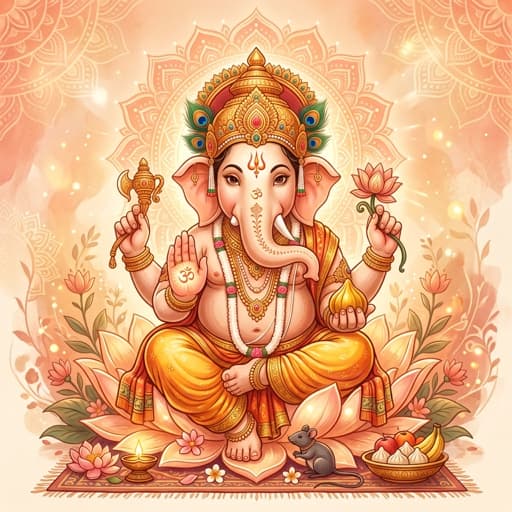
Raajit Mani Muktan Ur Maala.
Swarn Mukut Shir Nayan Vishaala.
A garland of gems and pearls shines upon your chest; a golden crown adorns your head, and your eyes are large and full of grace.
Pustak Pani Kuthaar Trishoolam.
Modak Bhog Sugandhit Phoolam.
In your hands you hold a book, an axe, and a trident; you are offered modak sweets and fragrant flowers.
Sundar Peetambar Tan Saajit.
Charan Paaduka Muni Man Raajit.
Your form is adorned with a beautiful yellow garment; the sandals upon your feet delight the minds of sages.
Dhani Shivsuvan Shanaanan Bhraata.
Gauri Lalan Vishwa-Vidhata.
Blessed son of Shiva, brother of the six-faced Kartikeya (Shadanan), beloved child of Gauri, and ordainer of the whole universe.
Riddhi Siddhi Tav Chanvar Dulaave.
Mushak Vaahan Sohat Dvaare.
Your consorts Riddhi and Siddhi wave the ceremonial fly-whisk over you; your mouse-vehicle sits in beauty at your door.
Kahau Janm Shubh Katha Tumhari.
Ati Shuchi Paavan Mangal Kaari.
Let me now tell the auspicious tale of your birth — a story utterly pure, sanctifying, and bringer of good fortune.
Ek Samay Giriraaj Kumaari.
Putra Hetu Tap Keenha Bhaari.
Once, the daughter of the mountain-king (Parvati) performed intense austerities, longing for a son.
Bhayo Yagya Jab Poorn Anoopa.
Tab Pahunchyo Tum Dhari Dwij Roopa.
When her matchless sacred rite reached completion, you arrived there, having assumed the form of a Brahmin.
Atithi Jaani Kai Gauri Sukhaari.
Bahu Vidhi Seva Kari Tumhaari.
Recognizing you as a guest, Gauri was overjoyed and served you with devotion in many ways.
Ati Prasanna Hvai Tum Var Deenha.
Maatu Putra Hit Jo Tap Keenha.
Deeply pleased, you granted a boon to the mother who had undertaken such austerity for the sake of a son.
Milhi Putra Tuhi Buddhi Vishaala.
Bina Garbh Dhaaran Yahi Kaala.
You said, "You shall obtain a son of vast wisdom, and this time, without carrying him in the womb."
Gannayak Gun Gyaan Nidhaana.
Poojit Pratham Roop Bhagvaana.
"He shall be commander of the Ganas (Shiva's attendant hosts), a treasury of virtue and knowledge, worshipped first among all forms of the divine."
As Kahi Antardhan Roop Hvai.
Palna Par Baalak Swaroop Hvai.
Having spoken thus, you vanished from sight, and then appeared upon the cradle in the form of an infant.
Bani Shishu Rudan Jabahi Tum Thaana.
Lakhi Mukh Sukh Nahin Gauri Samaana.
The moment you, as the infant, began to cry, Gauri's joy at beholding your face knew no equal.
Sakal Magan Sukh Mangal Gaavhin.
Nabh Te Suran Suman Varshaavhin.
Everyone was immersed in joy, singing songs of auspiciousness, while the gods showered flowers from the heavens.
Shambhu Uma Bahudaan Lutaavhin.
Sur Muni Jan Sut Dekhan Aavhin.
Shambhu (Shiva) and Uma (Parvati) distributed abundant gifts in celebration; gods, sages, and common folk came to see the newborn son.
Lakhi Ati Aanand Mangal Saaja.
Dekhan Bhi Aaye Shani Raaja.
Beholding this great festival of joy and auspiciousness, King Shani (Saturn) too came to see the child.
Nij Avgun Guni Shani Man Maaheen.
Baalak Dekhan Chaahat Naaheen.
Mindful of his own affliction (his gaze that brings harm), Shani, within his heart, did not wish to look upon the child.
Girja Kachhu Man Bhed Badhaayo.
Utsav Mor Na Shani Tuhi Bhaayo.
Girija, sensing his reluctance, said, "It seems, O Shani, that my celebration does not please you."
Kahan Lage Shani Man Sakuchaai.
Ka Karihau Shishu Mohi Dikhaai.
Shani, hesitant at heart, replied, "What will you gain by showing the infant to me?"
Nahin Vishwaas Uma Kar Bhayau.
Shani Son Baalak Dekhan Kahyau.
Uma did not accept his reluctance and insisted that Shani look upon the child.
Padtahin Shani Drig Kon Prakaasha.
Baalak Shir Udi Gayo Aakaasha.
The instant Shani's sidelong glance fell upon him, the infant's head flew off into the sky.
Girja Girin Vikal Hvai Dharni.
So Dukh Dasha Gayo Nahin Varni.
Girija collapsed to the ground in anguish; that state of sorrow is beyond description.
Hahaakaar Machyo Kailaasha.
Shani Keenhyon Lakhi Sut Ko Naasha.
An uproar of lamentation arose across Kailash, seeing that Shani's glance had destroyed the son.
Turat Garud Chadhi Vishnu Sidhaaye.
Kaati Chakra So Gaj Shir Laaye.
At once Vishnu mounted Garuda and set forth; with his discus he severed the head of an elephant and brought it back.
Baalak Ke Dhad Oopar Dhaaryo.
Praan Mantra Padh Shankar Daaryo.
The elephant's head was placed upon the child's body, and Shankar (Shiva), reciting the life-giving mantra, restored his breath.
Naam Ganesh Shambhu Tab Keenhe.
Pratham Poojya Buddhi Nidhi Var Deenhe.
Shambhu then named him Ganesh and granted him the boon of being worshipped first, the very treasury of wisdom.
Buddhi Pareeksha Jab Shiv Keenha.
Prithvi Ki Pradakshina Leenha.
When Shiva devised a test of wisdom, he set the circling of the earth as its measure.
Chale Shadaanan Bharmi Bhulaai.
Rachi Baith Tum Buddhi Upaai.
The six-faced Kartikeya set off at once, caught up in the race, while you, remaining seated, devised a wise strategy.
Charan Maatu-Pitu Ke Dhar Leenhen.
Tinke Saat Pradakshin Keenhen.
You took hold of your parents' feet and circled around them seven times.
Dhani Ganesh Kahi Shiv Hiy Harshey.
Nabh Te Suran Suman Bahu Barse.
Shiva's heart rejoiced and he declared, "Blessed is Ganesh!" — and from the heavens the gods showered abundant flowers.
Tumhri Mahima Buddhi Badaai.
Shesh Sahas Mukh Sakai Na Gaai.
Your glory and the greatness of your wisdom cannot be fully sung even by Shesha, the serpent of a thousand heads, with all his mouths.
Main Mati Heen Maleen Dukhaari.
Karahun Kaun Bidhi Vinay Tumhaari.
I am devoid of wisdom, impure of heart, and sorrowful — in what manner shall I offer my humble prayer to you?
Bhajat Ramsundar Prabhudaasa.
Lakh Prayaag Kakra Durvaasa.
This servant of yours, Ramsundar, dwelling near Prayag at Kakra, worships you.
Ab Prabhu Daya Deen Par Keejai.
Apni Shakti Bhakti Kuchh Deejai.
Now, O Lord, show mercy upon this humble servant; grant me some portion of your power and devotion.
Doha
Shri Ganesh Yah Chaleesa Paath Karein Dhar Dhyaan.
Nit Nav Mangal Grih Basai Lahe Jagat Sanmaan.
Whoever recites this Shri Ganesh Chalisa with focused devotion shall have ever-new auspiciousness dwell in their home and shall attain honor in the world.
Samvat Apan Sahastra Dash Rishi Panchami Dinesh.
Pooran Chaleesa Bhayo Mangal Moorti Ganesh.
This closing couplet records, in the traditional numeral-word convention, the Samvat year and the Panchami tithi on which this Chalisa to Ganesh, the embodiment of auspiciousness, was completed.
Frequently Asked Questions
When should the Ganesh Chalisa be recited?
The Ganesh Chalisa is traditionally recited during the morning or evening worship of Lord Ganesha, and especially on the deity's sacred days. Reciting it daily — or for forty days — is a common devotional practice.
How many verses are there in a Chalisa?
A chalisa is a devotional hymn of forty (chālīs) chaupai verses, usually framed by opening and closing doha couplets, composed here in praise of Lord Ganesha.
What are the benefits of reciting the Ganesh Chalisa?
Reciting the Ganesh Chalisa with faith is traditionally believed to invoke the grace of Lord Ganesha, steady the mind, and bring courage and inner peace. It is offered as an act of bhakti (devotion), not as a guarantee of any specific material result.