

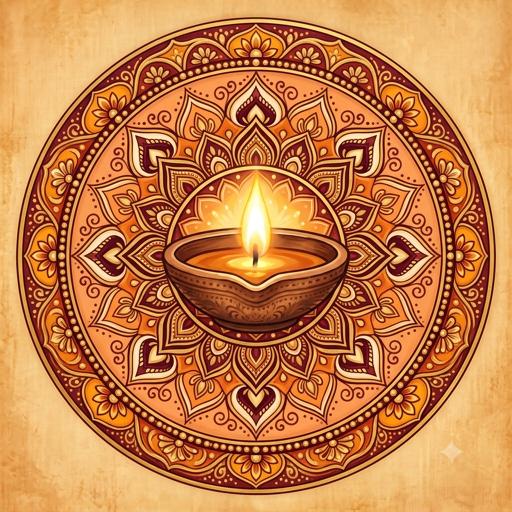
Hindu Aarti Collection
Authentic Hindu Aartis in Devanagari & English with interactive stanza meaning and printable PDFs.
What is an Aarti? (Key Points)
- Sacred Hindu light ritual where a lit ghee or camphor lamp is waved before a Devata with devotional singing.
- Performed daily at dawn and dusk at the conclusion of puja in temples and households.
- Includes 57 authentic aartis with Devanagari lyrics, English transliteration, stanza meanings, and dual PDFs.
All 57 Aartis (complete list)
Hindu Aarti Vidhi & Tradition — Frequently Asked Questions
Which aarti should be sung first and last in a Hindu puja?
Every Hindu puja begins with Lord Ganesha’s aarti ("Jai Ganesh Jai Ganesh Deva") as Pratham Pujya to remove obstacles, followed by the presiding family or festival Devata’s aarti, and concludes with the universal Vishnu aarti ("Om Jai Jagdish Hare") and "Karpuragauram Karunavataram".
In which direction and how many times is the aarti lamp rotated?
The aarti thali is always rotated clockwise in the shape of "Om" — traditionally 4 times at the Devata’s lotus feet, 2 times at the navel, 1 time before the face, and 7 times around the entire divine form.
Why are camphor (kapoor) and cow-ghee lamps used in aarti?
Camphor burns completely without leaving ash, symbolizing the dissolution of ego (ahankara) before the Divine, while a cow-ghee flame radiates sattvic purity across the worship space.
What are the traditional timings for daily morning and evening aarti?
Morning aarti (Kakad or Mangala Aarti) is performed after bathing during Brahma Muhurat or sunrise, and evening aarti (Sandhya Aarti) is performed at dusk during Pradosh Kaal when lamps are lit at home.
What is the ritual after singing the aarti (Jal-Pradakshina & Aarti Grahana)?
After singing, water is circled three times around the lamp (Jal-Pradakshina) to cool the flame’s tejas, flower petals (Pushpanjali) are offered at the deity’s feet, and devotees cup both palms over the flame to touch their forehead and crown.
Why are a bell (ghanti) and conch (shankh) sounded during aarti?
In Agama and Vedic tradition, the resonance of the puja bell (ghanta-nada) and conch (shankha-dhvani) creates an auspicious vibration resembling Pranava ("Om") that clears distracting thoughts and sanctifies the household.
How many wicks (batti) should be lit in an aarti lamp?
An odd number of wicks — 1 (Ekarti), 3, 5 (Pancharti, representing the five pranas and five elements), or 7 — is considered auspicious in Hindu ritual; even-numbered wicks (such as 2 or 4) are avoided.
What is the difference between an Aarti, a Chalisa, and a Bhajan?
An Aarti is a concluding ritual hymn sung while waving a lit lamp before the deity; a Chalisa is a 40-verse Doha–Chaupai prayer recited during japa/path before the aarti; and a Bhajan is a devotional song of love and remembrance sung at any time.