
Annapurna Mata Aarti (जय अन्नपूर्णा माता)
Navratri Ashtami (Kanya Bhoj), daily kitchen puja, Akshaya Tritiya, Monday with Shiva puja
About this Aarti
Annapurna Mata Aarti venerates the goddess of nourishment in Varanasi — from whom Lord Shiva Himself begged alms — who blesses every household kitchen with abundance.
Navratri Ashtami (Kanya Bhoj), daily kitchen puja, Akshaya Tritiya, Monday with Shiva puja
Significance & Importance
Goddess Annapurna, honoured in the aarti 'Jai Annapurna Mata,' is the divine embodiment of nourishment — a form of Parvati enshrined at Varanasi beside Kashi Vishwanath, presiding as the city's eternal provider of food, grace, and sustenance for all who come.
Tradition holds that Shiva once declared food to be maya and beneath the renunciant's concern. Parvati withdrew all sustenance from the world; realising that even ascetic life cannot be sustained without anna, Shiva came as a beggar to Kashi and received alms from Annapurna. The verse 'Shiv Ji Mangte Bhiksha, Parvati Poojya Naari' encodes this: the Mother of nourishment is supreme even over the Lord of renunciation.
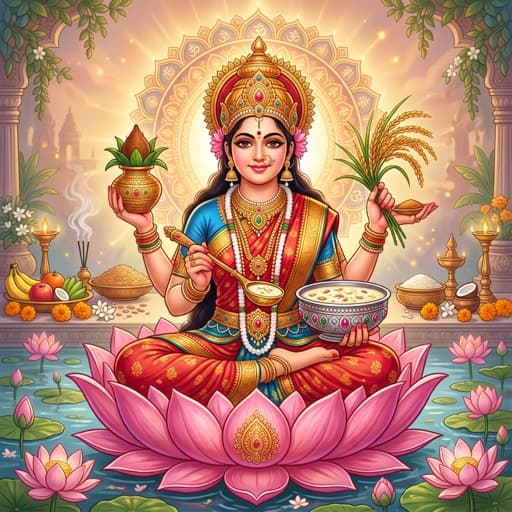
Annapurna's iconography — ladle in one hand, brimming food-vessel in the other — embodies her readiness to feed all. 'Jo Aata Khali Haath, Bharkar Jaata Dubara' voices her promise: none leave her empty. 'Rasoi Mein Maa Ka Vaas' sanctifies the kitchen as her dwelling, making every meal a sacred act.
She is worshipped on Navratri Ashtami through Kanya Bhoj — the beloved ritual of feeding young girls as living forms of the goddess. Annakut (day after Diwali) and Annapurna Jayanti also centre on her grace. Devotees offer this aarti to seek abundance, family health, and the wisdom that recognises every meal as prasad — the divine Mother's gift.
English Transliteration
Jai Annapurna Mata, Maiya Jai Annapurna Mata.
Kashi Vishwanath Patni, Jagat Ko Ann-Daata.
Jai Annapurna Mata.

Haath Mein Kamandal Shobhe, Ann-Paatra Dhari.
Shiv Ji Mangte Bhiksha, Parvati Poojya Naari.
Jai Annapurna Mata.

Kashi Mein Tera Darbar, Annapurna Bhandara.
Jo Aata Khali Haath, Bharkar Jaata Dubara.
Jai Annapurna Mata.

Rasoi Mein Maa Ka Vaas, Ann-Dhanya Ki Daata.
Ghar Mein Jo Maa Ki Puja, Vo Kabhi Na Bhookha.
Jai Annapurna Mata.

Navratri Ashtami Par, Kanya Bhoj Karate.
Annapurna Maa Ki Kripa Se, Sab Manorath Paate.
Jai Annapurna Mata.
Verse-by-Verse Meaning
Tap “Show meaning” under any line to read its bhāvārth.
Jai Annapurna Mata, Maiya Jai Annapurna Mata. Kashi Vishwanath Patni, Jagat Ko Ann-Daata.
Show meaningHide meaning
Victory to you, Mother Annapurna; victory to you, dear Mother. You are the consort of Vishwanath (Lord Shiva), the Lord of Kashi, and you are the giver of food (ann) to the entire world.
Jai Annapurna Mata.
Show meaningHide meaning
(Refrain — the central line of the aarti, repeated throughout)
Haath Mein Kamandal Shobhe, Ann-Paatra Dhari. Shiv Ji Mangte Bhiksha, Parvati Poojya Naari.
Show meaningHide meaning
A kamandal (ascetic's water-pot) graces your hand, and you hold the vessel filled with food. Even Lord Shiva himself begs alms (food) from you — O Mother in the form of Parvati, you are the venerable Goddess.
Jai Annapurna Mata.
Show meaningHide meaning
(Refrain)
Kashi Mein Tera Darbar, Annapurna Bhandara. Jo Aata Khali Haath, Bharkar Jaata Dubara.
Show meaningHide meaning
In Kashi (Varanasi) is your court (temple), where the inexhaustible storehouse of Annapurna abides. Whoever comes empty-handed (destitute) returns once again filled and fulfilled.
Jai Annapurna Mata.
Show meaningHide meaning
(Refrain)
Rasoi Mein Maa Ka Vaas, Ann-Dhanya Ki Daata. Ghar Mein Jo Maa Ki Puja, Vo Kabhi Na Bhookha.
Show meaningHide meaning
O Mother, your dwelling is in the kitchen of the home; you are the bestower of food and grain. Whoever worships the Mother in their home never goes hungry.
Jai Annapurna Mata.
Show meaningHide meaning
(Refrain)
Navratri Ashtami Par, Kanya Bhoj Karate. Annapurna Maa Ki Kripa Se, Sab Manorath Paate.
Show meaningHide meaning
On the Ashtami (eighth day) of Navratri, devotees hold the Kanya-Bhoj, feeding young girls (as forms of the Goddess). By the grace of Mother Annapurna, all attain the fulfilment of their heartfelt wishes (manorath).
Jai Annapurna Mata.
Show meaningHide meaning
(Refrain)
More aartis you may love
Find an aarti by occasion
Frequently Asked Questions
When should the Annapurna Mata Aarti be recited?
Navratri Ashtami (Kanya Bhoj), daily kitchen puja, Akshaya Tritiya, Monday with Shiva puja
What are the benefits of reciting the Annapurna Mata Aarti?
Reciting the Annapurna Mata Aarti with devotion is traditionally believed to invoke the grace of Annapurna Mata, steady the mind, dispel negativity, and create an auspicious, sattvic atmosphere at home. It is offered as an act of bhakti (loving devotion) rather than for any guaranteed material result.
Where can I read the complete Annapurna Mata Aarti lyrics?
VedKosh provides the complete Annapurna Mata Aarti lyrics dedicated to Annapurna Mata (अन्नपूर्णा माता) in both Hindi and English (with transliteration for regional readers), along with its meaning and a printable/downloadable version.