
Jai Mata Di Aarti (जय माता दी)
Navratri, Vaishno Devi yatra, every morning and evening at Mata temples
About this Aarti
Jai Mata Di is the iconic aarti synonymous with Vaishno Devi pilgrimage and Navratri festivals, beloved by millions of devotees.
Navratri, Vaishno Devi yatra, every morning and evening at Mata temples
Significance & Importance
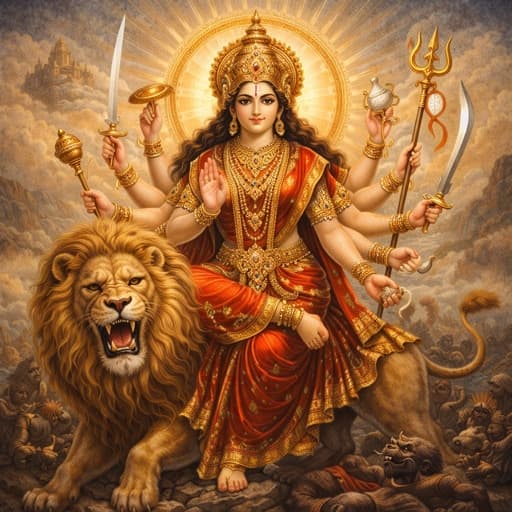
'Jai Mata Di' is far more than a song — it is the universal devotional cry (jaikara) of millions, the sound of surrender to Maa Durga, Vaishno Devi and the Divine Mother (Shakti). It rings out at every step of the pilgrimage to Mata Vaishno Devi's cave shrine on the Trikuta hills near Katra (Jammu & Kashmir), and it brings every Shakti temple alive through the nine nights of Navratri.
By tradition, Mata Vaishno Devi is worshipped as the combined form of the three great powers — Mahakali, Mahalakshmi and Mahasaraswati — who grant darshan to devotees in the form of three natural rock pindis rather than an image. The cry 'Jai Mata Di' ('Victory to the Divine Mother') expresses love, refuge (sharanagati) and gratitude toward this Adi-Shakti, the Mother revered as the source and sustainer of all. Devotees raise it in greeting, in thanksgiving, and at the climax of every aarti.
Note: The popular modern, film/album-style song carrying this title is under copyright, so its full lyrics are not reproduced on this page; the invocation and its devotional spirit are explained here instead. For singing a complete, traditional Mother-Goddess aarti, see the public-domain 'Jai Ambe Gauri' and 'Ambe Tu Hai Jagdambe Kali'.
English Transliteration
🔸 The popular bhajan widely known by the title 'Jai Mata Di' is a modern composition (Hindi–Urdu idiom, likely written after 1965) and may still be under copyright (Indian law: author's lifetime + 60 years). Out of respect for copyright, its full lyrics are not reproduced here.

'Jai Mata Di' is, in essence, a sacred devotional cry (jaikara) to Maa Durga / Vaishno Devi. Its meaning and significance are given in the 'Significance & Importance' section below.

For traditional, public-domain Mata aartis, please see 'Jai Ambe Gauri' and 'Ambe Tu Hai Jagdambe Kali'.
More aartis you may love
Find an aarti by occasion
Frequently Asked Questions
When should the Jai Mata Di Aarti be recited?
Navratri, Vaishno Devi yatra, every morning and evening at Mata temples
What are the benefits of reciting the Jai Mata Di Aarti?
Reciting the Jai Mata Di Aarti with devotion is traditionally believed to invoke the grace of Mata Vaishno Devi, steady the mind, dispel negativity, and create an auspicious, sattvic atmosphere at home. It is offered as an act of bhakti (loving devotion) rather than for any guaranteed material result.
Where can I read the complete Jai Mata Di Aarti lyrics?
VedKosh provides the complete Jai Mata Di Aarti lyrics dedicated to Mata Vaishno Devi (वैष्णो देवी) in both Hindi and English (with transliteration for regional readers), along with its meaning and a printable/downloadable version.