Navdurga Aarti (जय जय नव दुर्गा माता)
Both Navratri (Chaitra and Sharad), Dussehra; each form worshipped on the corresponding Navratri day
About this Aarti
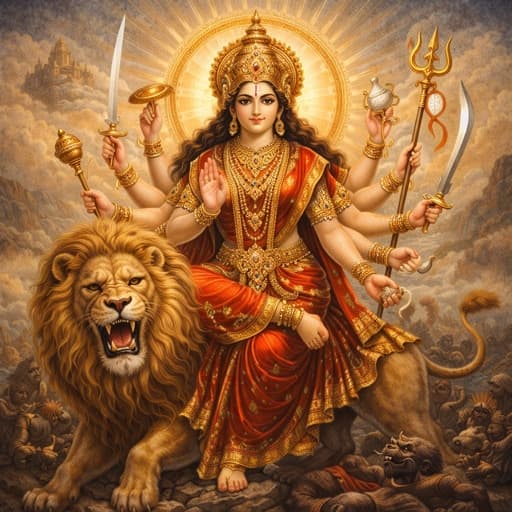
Navdurga Aarti is the collective prayer to all nine forms of Goddess Durga during Navratri — sung across both Chaitra and Sharad Navratri in every Shakti temple.
Both Navratri (Chaitra and Sharad), Dussehra; each form worshipped on the corresponding Navratri day
Significance & Importance
'Jai Jai Nav Durga Mata' is the collective invocation of all nine forms of Goddess Durga — Shailaputri through Siddhidatri — worshipped across Navratri's nine nights, serving as the unifying hymn of the most widely observed Shakti festival in the Hindu devotional year.
Navratri is celebrated twice annually — as Chaitra Navratri in spring and as Sharad Navratri in autumn — culminating on Vijayadashami (the tenth day), which celebrates the Divine Mother's ultimate victory over the forces of ignorance and adharma. Each form is worshipped on her corresponding Navratri day: Shailaputri (daughter of Himalaya) on the first, Brahmacharini (the ascetic) on the second, Chandraghanta on the third, Kushmanda on the fourth, Skandamata on the fifth, Katyayani on the sixth, Kalaratri on the seventh, Mahagauri on the eighth, and Siddhidatri — bestower of all spiritual perfections — on the ninth.
According to the Devi Mahatmya of the Markandeya Purana, these nine forms trace the soul's complete spiritual journey — from the grounding discipline of Shailaputri through the intense austerity of Brahmacharini, the warrior's courage of Chandraghanta and Katyayani, the dissolution of darkness through Kalaratri, and the final radiant fulfillment of Siddhidatri, who bestows upon devoted seekers all eight siddhis and the grace of moksha.
This aarti is sung daily during both Navratris in Shakti temples, homes, and community pandals across India — from Mata Vaishno Devi in Jammu to Kamakhya in Assam. Devotees observe fasts, perform havan, and recite the Durga Saptashati alongside this aarti, seeking fearlessness, strength, clarity of purpose, dissolution of obstacles, and the grace that guides the soul toward its highest realization.
English Transliteration
Jai Jai Nav Durga Mata, Jai Nav Durga Mata.
Shailputri Brahmacharini, Chandraghanta Mata.
Jai Jai Nav Durga Mata.

Kushmanda Skandamata, Katyayani Devi.
Kalaratri Mahagauri, Siddhidatri Maa.
Jai Jai Nav Durga Mata.

Navratri Ke Nav Din Mein, Nav Roop Pujaate.
Maa Durga Ki Kripa Se, Sab Vighn Mitaate.
Jai Jai Nav Durga Mata.

Prathm Diwas Shailputri, Man Ko Shaant Karti.
Dwitiya Brahmacharini, Bhakti Ko Poorn Karti.
Jai Jai Nav Durga Mata.

Dashami Ko Shakti Ki, Hoti Vijay Dashami.
Nav Durga Mata Ki, Jai Jai Navratri.
Jai Jai Nav Durga Mata.
Verse-by-Verse Meaning
Tap “Show meaning” under any line to read its bhāvārth.
Jai Jai Nav Durga Mata, Jai Nav Durga Mata. Shailputri Brahmacharini, Chandraghanta Mata.
Show meaningHide meaning
Hail, hail to Mother Navadurga, victory to Mother Navadurga! Of the Mother's nine forms, the first three are named here — Shailputri (daughter of the mountain-king), Brahmacharini (goddess of penance), and Chandraghanta (who bears a bell-shaped crescent moon on Her brow).
Jai Jai Nav Durga Mata.
Show meaningHide meaning
(Refrain — glory to Mother Navadurga; repeated hereafter.)
Kushmanda Skandamata, Katyayani Devi. Kalaratri Mahagauri, Siddhidatri Maa.
Show meaningHide meaning
The next six goddesses are named — Kushmanda (who created the universe with Her gentle smile), Skandamata (mother of Skanda, i.e. Kartikeya), Goddess Katyayani, Kalaratri, Mahagauri, and Mother Siddhidatri. Thus the Mother's nine forms are complete.
Jai Jai Nav Durga Mata.
Show meaningHide meaning
(Refrain — repeated.)
Navratri Ke Nav Din Mein, Nav Roop Pujaate. Maa Durga Ki Kripa Se, Sab Vighn Mitaate.
Show meaningHide meaning
During the nine days of Navratri these very nine forms of the Mother are worshipped; and by the grace of Maa Durga all the devotees' obstacles (vighn) are wiped away.
Jai Jai Nav Durga Mata.
Show meaningHide meaning
(Refrain — repeated.)
Prathm Diwas Shailputri, Man Ko Shaant Karti. Dwitiya Brahmacharini, Bhakti Ko Poorn Karti.
Show meaningHide meaning
On the first day Shailputri is worshipped, who brings peace to the devotee's mind; on the second day Brahmacharini is worshipped, who brings the devotee's devotion to fullness.
Jai Jai Nav Durga Mata.
Show meaningHide meaning
(Refrain — repeated.)
Dashmi Ko Shakti Ki, Hoti Vijay Dashmi. Nav Durga Mata Ki, Jai Jai Navratri.
Show meaningHide meaning
On the tenth day (Dashami), after Navratri, the festival of the Goddess's triumph, 'Vijaya Dashami', is celebrated. Glory to Mother Navadurga, and glory to this sacred Navratri! (This closing stanza appears in the Hindi lyric but is missing from the romanized lyricsEn; transliteration supplied here.)
Jai Jai Nav Durga Mata.
Show meaningHide meaning
(Refrain — repeated.)
More aartis you may love
Find an aarti by occasion
Frequently Asked Questions
When should the Navdurga Aarti be recited?
Both Navratri (Chaitra and Sharad), Dussehra; each form worshipped on the corresponding Navratri day
What are the benefits of reciting the Navdurga Aarti?
Reciting the Navdurga Aarti with devotion is traditionally believed to invoke the grace of Navdurga— Nine Forms of Durga, steady the mind, dispel negativity, and create an auspicious, sattvic atmosphere at home. It is offered as an act of bhakti (loving devotion) rather than for any guaranteed material result.
Where can I read the complete Navdurga Aarti lyrics?
VedKosh provides the complete Navdurga Aarti lyrics dedicated to Navdurga (नवदुर्गा) — Nine Forms of Durga in both Hindi and English (with transliteration for regional readers), along with its meaning and a printable/downloadable version.