Satyanarayan Aarti (सत्यनारायण जी की आरती)
Satyanarayan Puja (Purnima, auspicious occasions, griha pravesh, marriage ceremonies)
About this Aarti
Satyanarayan Aarti is the concluding prayer of Satyanarayan Puja, performed for fulfillment of wishes and household blessings.
Satyanarayan Puja (Purnima, auspicious occasions, griha pravesh, marriage ceremonies)
Significance & Importance
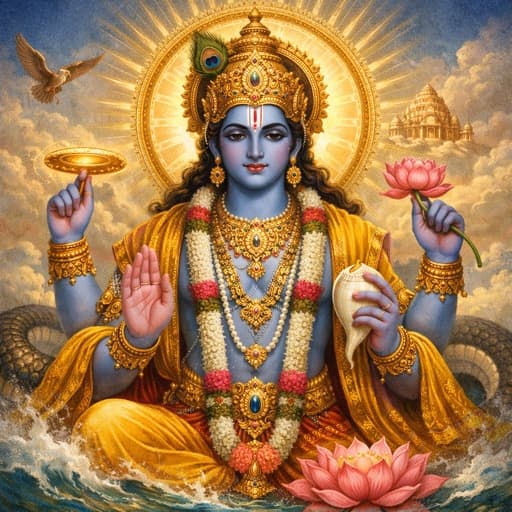
'Jai Lakshmi Ramana' is the sacred concluding hymn of the Satyanarayan Vrat and Katha — one of the most widely observed household rituals in Hindu family life — sung to honor Lord Vishnu as Satyanarayan, the embodiment of eternal Truth (Satya) and beneficent grace.
The Satyanarayan Katha narrates a series of parables in which Lord Vishnu instructs the celestial sage Narada on the merits of observing this vrat. The narrative teaches three intertwined virtues: faith (shraddha), truthfulness (satya), and gratitude — for those who neglect to complete the vow or forget to honor the prasad face reversal of fortune, while those who fulfill it sincerely receive household harmony and the fulfillment of their deepest wishes.
This aarti addresses the Lord as 'Ratnakar Manthan, Tribhuvan Mohan' — the one who captivated the three worlds and participated in the churning of the cosmic ocean — confirming the identity of Satyanarayan with the supreme Narayana who reclines on the serpent Shesh. The hymn extols him as giver of all four human goals: dharma (righteous conduct), artha (prosperity), kama (fulfillment of desires), and moksha (liberation) — making this a holistic invocation of the complete spiritual life, not merely a ritual prayer.
The Satyanarayan Puja is traditionally performed on Purnima (every full-moon night) and on auspicious occasions such as housewarming (griha pravesh), weddings, business inaugurations, and thanksgiving after any great boon received. The sharing of consecrated prasad among all present is an essential part of the ritual — a tangible expression of gratitude and communal blessing. This aarti, sung at the puja's close, seals the ceremony with collective devotion.
English Transliteration
Jai Lakshmi Ramana, Swami Jai Lakshmi Ramana.
Satyanarayan Swami, Jan-Patak Harana.
Jai Lakshmi Ramana.

Ratnakar Manthan, Tribhuvan Mohan.
Raj Shesh Shayana, Jai Jai Lakshmi Ramana.
Jai Lakshmi Ramana.

Dharm Arth Kaam Moksh, Daatar Jagpala.
Riddhi Siddhi Mangaldaata, Sukhdaata Dayala.
Jai Lakshmi Ramana.

Paap Karm Son Peedit, Ati Dukhdayak.
Bhav Se Taaran Kaaran, Jai Jai Jagnayak.
Jai Lakshmi Ramana.

Shri Lakshmi Ramana, Jai Jai Lakshmi Ramana.
Satyanarayan Swami, Jan-Patak Harana.
Jai Lakshmi Ramana.
Verse-by-Verse Meaning
Tap “Show meaning” under any line to read its bhāvārth.
Jai Lakshmi Ramana, Swami Jai Lakshmi Ramana. Satyanarayan Swami, Jan-Patak Harana.
Show meaningHide meaning
Victory to the beloved Lord of Lakshmi (Vishnu); victory to you, O Lord. O Lord Satyanarayan, you are the remover of the sins (patak) of your devotees.
(This is the refrain; in later repetitions of "Jai Lakshmi Ramana" the meaning is not re-translated.) Ratnakar Manthan, Tribhuvan Mohan.
Show meaningHide meaning
You are the one who appeared at the churning of the ocean (Ratnakar, the treasure-mine of jewels) and the one who enchants all three worlds.
Raj Shesh Shayana, Jai Jai Lakshmi Ramana.
Show meaningHide meaning
You recline majestically upon the serpent Shesha; victory, victory to you, O beloved Lord of Lakshmi.
Jai Lakshmi Ramana.
Show meaningHide meaning
(refrain)
Dharm Arth Kaam Moksh, Daatar Jagpala.
Show meaningHide meaning
You are the giver of all four aims of life — dharma (righteousness), artha (wealth), kama (desire) and moksha (liberation) — and the protector of the world.
Riddhi Siddhi Mangaldaata, Sukhdaata Dayala.
Show meaningHide meaning
You are the bestower of prosperity (riddhi), spiritual attainment (siddhi) and auspiciousness, the giver of happiness, and the compassionate one.
Jai Lakshmi Ramana.
Show meaningHide meaning
(refrain)
Paap Karm son Peedit, Ati Dukhdaayak.
Show meaningHide meaning
For those afflicted by sinful deeds and steeped in great sorrow, you are the refuge.
Bhav se Taaran Kaaran, Jai Jai Jagnayak.
Show meaningHide meaning
You are the cause of deliverance across the ocean of worldly existence (bhava); victory, victory to you, O Lord of the world.
Jai Lakshmi Ramana.
Show meaningHide meaning
(refrain)
Shri Lakshmi Ramana, Jai Jai Lakshmi Ramana.
Show meaningHide meaning
O glorious Lord of Lakshmi, victory, victory to you again and again.
Satyanarayan Swami, Jan-Patak Harana.
Show meaningHide meaning
O Lord Satyanarayan, remover of the devotees' sins. (Closing reprise of the opening refrain.)
Jai Lakshmi Ramana.
Show meaningHide meaning
(refrain)
More aartis you may love
Find an aarti by occasion
Frequently Asked Questions
When should the Satyanarayan Aarti be recited?
Satyanarayan Puja (Purnima, auspicious occasions, griha pravesh, marriage ceremonies)
What are the benefits of reciting the Satyanarayan Aarti?
Reciting the Satyanarayan Aarti with devotion is traditionally believed to invoke the grace of Satyanarayan, steady the mind, dispel negativity, and create an auspicious, sattvic atmosphere at home. It is offered as an act of bhakti (loving devotion) rather than for any guaranteed material result.
Where can I read the complete Satyanarayan Aarti lyrics?
VedKosh provides the complete Satyanarayan Aarti lyrics dedicated to Satyanarayan (सत्यनारायण) in both Hindi and English (with transliteration for regional readers), along with its meaning and a printable/downloadable version.