Jagannath Aarti (जय जगन्नाथ स्वामी)
Rath Yatra (Ashadha Shukla Dwitiya), Snana Purnima, Navakalevara, daily at Puri Jagannath Temple
About this Aarti
Jagannath Swami Aarti honours Lord Jagannath of Puri Dhama — one of the four sacred Dhamas — whose annual Rath Yatra draws millions of devotees worldwide.
Rath Yatra (Ashadha Shukla Dwitiya), Snana Purnima, Navakalevara, daily at Puri Jagannath Temple
Significance & Importance
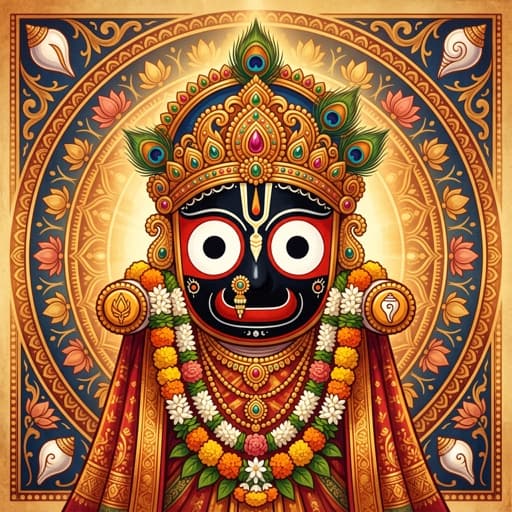
'Jai Jagannath Swami' is the devotional salutation to the Lord of the Universe, worshipped in his wooden form (Daru-brahma) at Puri — one of the four Char Dhamas — alongside elder brother Balabhadra and sister Subhadra, forming the sacred triad of Jagannath worship.
Lord Jagannath is understood in the Vaishnava tradition as a form of Krishna/Vishnu who manifested as Daru-brahma — the Brahman descended into sacred neem wood. The theological significance of this wooden image is extraordinary: according to tradition, when the divine craftsman carving the image asked not to be disturbed, the king opened the door prematurely, leaving the image without hands and with large circular eyes. This is precisely how Jagannath is worshipped — signifying that the formless Brahman can never be fully contained within form, and that divine grace transcends human ideas of completeness.
The aarti names the three sacred chariots of the annual Rath Yatra (Ashadha Shukla Dwitiya): Nandighosh (Jagannath's), Taladhwaja (Balabhadra's), and Darpadalan (Subhadra's). The Rath Yatra — in which the three deities ride through Puri's streets on towering wooden chariots pulled by thousands of devotees — is one of the oldest and largest religious processions in the world, drawing millions annually. The Mahaprasad of Puri, distributed to all regardless of caste or creed, embodies a radical spiritual equality unique to Jagannath worship.
The Navakalevara ritual, performed at rare intervals, involves ceremonially replacing the old wooden images with freshly carved ones — making tangible the doctrine of the eternal spirit periodically renewing its form. Snana Purnima, when the deities are bathed publicly in the temple courtyard, is another occasion on which this aarti is sung with heightened devotional intensity across Odisha and among Jagannath devotees worldwide.
English Transliteration
Jai Jagannath Swami, Jai Jagannath.
Balbhadra Subhadra Sahit, Naman Karen Haath.
Jai Jagannath Swami.

Puri Ke Jagdish, Darubrahma Swaroop.
Bade Bhai Baldev Sang, Divya Roop Anoop.
Jai Jagannath Swami.

Rath Yatra Ke Avsar, Niklen Tinon Rath.
Nandighosh Garudhwaj Tal-Dhwaj, Bhakton Ka Path.
Jai Jagannath Swami.

Mahaprasad Mangte, Sab Nar Nari.
Jagannath Ke Darshan Se, Ho Jay Phal Bhari.
Jai Jagannath Swami.

Puri Ki Subhadra Rani, Niladri Mein Vaas.
Jagannath-Balbhadra-Subhadra, Tinon Ka Prakash.
Jai Jagannath Swami.
Verse-by-Verse Meaning
Tap “Show meaning” under any line to read its bhāvārth.
Jai Jagannath Swami, Jai Jagannath. Balbhadra Subhadra Sahit, Naman Karen Haath.
Show meaningHide meaning
Victory to you, Lord Jagannath! Seated together with brother Balabhadra and sister Subhadra, we bow to you with folded hands.
Jai Jagannath Swami.
Show meaningHide meaning
(Refrain — repeated at the close of every verse)
Puri Ke Jagdish, Darubrahma Swaroop. Bade Bhai Baldev Sang, Divya Roop Anoop.
Show meaningHide meaning
You are the Lord of Puri, the master of the universe, and the form of Brahman that has descended into daru (neem wood). Together with your elder brother Baldev (Balabhadra), your divine form is utterly matchless (anoop — beyond compare).
Jai Jagannath Swami.
Show meaningHide meaning
(Refrain)
Rath Yatra Ke Avsar, Niklen Tinon Rath. Nandighosh Garudhwaj Tal-Dhwaj, Bhakton Ka Path.
Show meaningHide meaning
On the occasion of the Rath Yatra, all three chariots (of Jagannath, Balabhadra and Subhadra) set forth. Nandighosh and Garudhwaj are two names of Jagannath's own single chariot, while Tal-Dhwaj (Taladhwaja) is elder brother Balabhadra's chariot; these chariots become the very path of the devotees, who follow behind them and receive darshan.
Jai Jagannath Swami.
Show meaningHide meaning
(Refrain)
Mahaprasad Mangte, Sab Nar Nari. Jagannath Ke Darshan Se, Ho Jay Phal Bhari.
Show meaningHide meaning
All men and women long to receive the Mahaprasad (the sacred offered food). Through the darshan of Jagannath one attains great (abundant) spiritual fruit.
Jai Jagannath Swami.
Show meaningHide meaning
(Refrain)
Puri Ki Subhadra Rani, Niladri Mein Vaas. Jagannath-Balbhadra-Subhadra, Tinon Ka Prakash.
Show meaningHide meaning
[line present in the Hindi lyric but omitted from the romanized lyricsEn] Goddess Subhadra, the queen of Puri, dwells at Niladri (Nilachal/Nilagiri — the sacred abode of Puri). Jagannath, Balabhadra and Subhadra — the divine radiance of all three shines forth everywhere.
Jai Jagannath Swami.
Show meaningHide meaning
(Refrain)
More aartis you may love
Find an aarti by occasion
Frequently Asked Questions
When should the Jagannath Aarti be recited?
Rath Yatra (Ashadha Shukla Dwitiya), Snana Purnima, Navakalevara, daily at Puri Jagannath Temple
What are the benefits of reciting the Jagannath Aarti?
Reciting the Jagannath Aarti with devotion is traditionally believed to invoke the grace of Jagannath, steady the mind, dispel negativity, and create an auspicious, sattvic atmosphere at home. It is offered as an act of bhakti (loving devotion) rather than for any guaranteed material result.
Where can I read the complete Jagannath Aarti lyrics?
VedKosh provides the complete Jagannath Aarti lyrics dedicated to Jagannath (जगन्नाथ) in both Hindi and English (with transliteration for regional readers), along with its meaning and a printable/downloadable version.