
Shri Ram Chandra Kripalu Bhaj Man Aarti (श्री रामचंद्र कृपालु भजु मन)
Sung at the conclusion of Ramayana paath, Sundar Kand recital, Ram Navami, and during morning/evening Vaishnava sandhya worship.
About this Aarti
Tulsidas's celebrated Vinaya-patrika stuti to Lord Rama, sung as a closing aarti for Ramayana paath, Ram Navami and Vaishnava sandhya worship.
Sung at the conclusion of Ramayana paath, Sundar Kand recital, Ram Navami, and during morning/evening Vaishnava sandhya worship.
Composed by Goswami Tulsidas (16th century) and included in the Vinaya-patrika, this stuti is one of the most beloved devotional verses to Lord Rama. Recited at Ayodhya, Janakpuri, Chitrakoot and in every Vaishnava household across India.
Significance & Importance
This stuti praises Rama as the lotus-eyed, lotus-faced ocean of mercy who destroys the cycle of birth and death. Goswami Tulsidas weaves Rama's divine beauty, his role as the destroyer of demon dynasties, and the ornaments and weapons that mark him as the eternal Raghunandana. Singing this purifies the heart and brings the bhakta closer to Sita-Rama charitable grace.
English Transliteration
Shri Ramachandra kripalu bhaj man, harana bhava bhaya darunam,
Navakanj-lochana kanj-mukha, kar-kanj pad-kanjarunam.

Kandarpa aganit amita chhabi, nava-nila-niraja-sundaram,
Patapita manahu taditaa ruchi-shuchi, naumi janaka-suta-varam.

Bhaju Dinabandhu Dinesha danava-daitya-vamsha-nikandanam,
Raghunanda anandakanda Koshalachanda Dasharatha-nandanam.

Sira mukuta kundala tilaka charu, udara anga vibhushanam,
Ajanu-bhuja shara-chapa-dhara, sangrama-jita-khara-dushanam.

Iti vadati Tulasidasa Shankara, sheshamuni-mana-ranjanam,
Mama hridaya-kanja nivasa kuru, Kamadi khala-dala-ganjanam.

Manu jahi rachehu milihi so baru, sahaja sundara saanvaro,
Karuna nidhana sujana sila sanehi, jaanata Ravari Aaravo.

Ehi bhaanti Gauri asisa suni siya, sahita hiya harashi ali,
Tulasi bhavanihi pujee puni puni, mudita mana mandira chali.
Verse-by-Verse Meaning
Tap “Show meaning” under any line to read its bhāvārth.
Shri Ramachandra kripalu bhaj man, harana bhava bhaya darunam, / Navakanj-lochana kanj-mukha, kar-kanj pad-kanjarunam.
Show meaningHide meaning
O mind, worship the compassionate Shri Ramachandra, who removes the terrible fear of worldly existence (the dread of birth and death). His eyes are like fresh-blooming lotuses, his face is lotus-like, his hands are like lotuses, and his feet are tender and red like a roseate lotus.
Kandarpa aganit amita chhabi, nava-nila-niraja-sundaram, / Patapita manahu taditaa ruchi-shuchi, naumi janaka-suta-varam.
Show meaningHide meaning
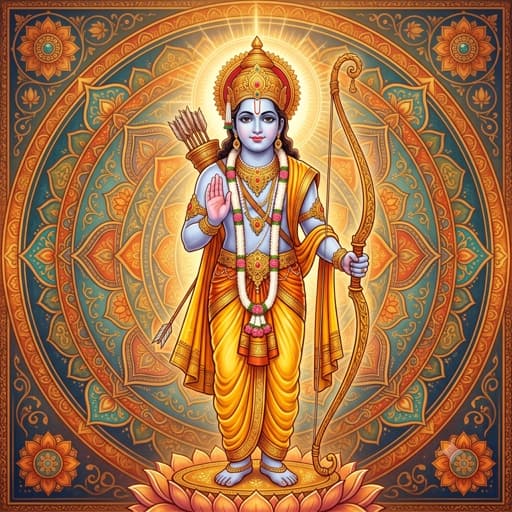
His beauty surpasses that of countless Kamadevas (gods of love); he is dark and lovely like a fresh blue lotus. His yellow garment shines as if it were a streak of lightning (against a dark cloud). To that pure Lord, the bridegroom of Janaka's daughter Sita, I offer my obeisance.
Bhaju Dinabandhu Dinesha danava-daitya-vamsha-nikandanam, / Raghunanda anandakanda Koshalachanda Dasharatha-nandanam.
Show meaningHide meaning
Worship the friend of the lowly, radiant as the sun (Dinesh), who utterly destroys the dynasties of danavas and daityas (demons). He is the joy of the Raghu line, the very root of bliss (ananda-kanda), the moon of the Kosala kingdom, and the cherished son of King Dasharatha.
Sira mukuta kundala tilaka charu, udara anga vibhushanam, / Ajanu-bhuja shara-chapa-dhara, sangrama-jita-khara-dushanam.
Show meaningHide meaning
A crown adorns his head, rings his ears, and a beautiful tilak his forehead; ornaments grace his noble, magnificent limbs. His arms reach down to his knees (ajanu-bahu); he bears bow and arrows, and in battle he vanquished the demons Khara and Dushana.
Iti vadati Tulasidasa Shankara, sheshamuni-mana-ranjanam, / Mama hridaya-kanja nivasa kuru, Kamadi khala-dala-ganjanam.
Show meaningHide meaning
Thus Tulsidas prays: O Lord who delights the hearts of Shankara (Shiva), Shesha-naga, and the sages — dwell in the lotus of my heart and destroy the host of wicked enemies such as lust, anger and the rest.
Manu jahi rachehu milihi so baru, sahaja sundara saanvaro, / Karuna nidhana sujana sila sanehi, jaanata Ravari Aaravo.
Show meaningHide meaning
(Mother Gauri blesses Sita:) The very bridegroom in whom your heart has become absorbed — that naturally beautiful, dark-hued Lord — shall be yours. He is the treasure-house of compassion, all-wise, virtuous and affectionate, and he fully knows your heart's earnest longing.
Ehi bhaanti Gauri asisa suni siya, sahita hiya harashi ali, / Tulasi bhavanihi pujee puni puni, mudita mana mandira chali.
Show meaningHide meaning
Hearing Mother Gauri's blessing in this manner, Sita, together with her companions (sakhis), rejoiced in her heart. Tulsidas says: worshipping Goddess Bhavani (Gauri) again and again, she set off for the palace with a gladdened mind.
More aartis you may love
Find an aarti by occasion
Frequently Asked Questions
When should the Shri Ram Chandra Kripalu Bhaj Man Aarti be recited?
Sung at the conclusion of Ramayana paath, Sundar Kand recital, Ram Navami, and during morning/evening Vaishnava sandhya worship.
What are the benefits of reciting the Shri Ram Chandra Kripalu Bhaj Man Aarti?
Reciting the Shri Ram Chandra Kripalu Bhaj Man Aarti with devotion is traditionally believed to invoke the grace of Rama, steady the mind, dispel negativity, and create an auspicious, sattvic atmosphere at home. It is offered as an act of bhakti (loving devotion) rather than for any guaranteed material result.
Where can I read the complete Shri Ram Chandra Kripalu Bhaj Man Aarti lyrics?
VedKosh provides the complete Shri Ram Chandra Kripalu Bhaj Man Aarti lyrics dedicated to Rama (राम) in both Hindi and English (with transliteration for regional readers), along with its meaning and a printable/downloadable version.