Bhagwan Krishna
श्री कृष्ण
About
Quick Facts
Iconography & Symbolism
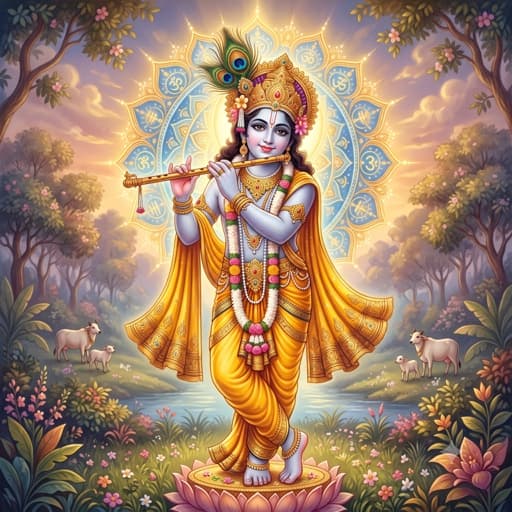
- Dark blue-hued (shyama) body, the colour of the infinite sky and deep water
- Peacock feather (mor mukut) in the crown, gifted by the peacocks of Vrindavan
- Bansuri (bamboo flute) held to the lips in the tribhanga three-bend stance
- Yellow silk pitambara, vaijayanti wildflower garland and the Kaustubha gem
- Bal Gopal form: crawling on one knee with a ball of butter (makhan) in the hand
- Parthasarathi form: holding the reins of Arjuna's chariot, discourse in mid-flow
Significance
Krishna is invoked for clarity in duty, courage in conflict, joy in devotion, and protection of children and family. His Gita is the practical handbook of dharma for householders.
Worship & Practice
Bal Gopal seva (bathing, dressing and feeding the infant deity daily), recitation of the Bhagavad Gita and the tenth Skandha of the Bhagavata, and chanting of the twelve-syllable mantra Om Namo Bhagavate Vasudevaya.
Prayers & Mantras
Janmashtami Vrat
The most rigorous of the Vaishnava fasts. It begins at sunrise on Bhadrapada Krishna Ashtami and is broken only after the midnight birth-puja — a full day and half a night of fasting and jagran (night vigil).
How to observe (Vidhi):
- Bathe before sunrise and take the sankalp facing east, naming the family for whose welfare the vrat is kept.
- Keep the day grain-free and salt-free; take only water or phalahaar if health requires it.
- Prepare the jhula (cradle) and the sringaar for Bal Gopal through the afternoon — new clothes, mor mukut, flute and tulsi.
- From dusk, recite the tenth Skandha of the Bhagavata or chant the Maha Mantra until the Nishita Kaal begins.
- At midnight perform the panchamrit abhishek, offer makhan-mishri and dhaniya panjiri, sing the janma aarti, then break the fast with charanamrit.
Prasad: Makhan-mishri (butter with rock sugar), dhaniya panjiri, panchamrit, and seasonal fruit. Where possible, the chappan bhog of fifty-six items.
Famous Temples
Festivals
Krishna Janmashtami
Krishna's birth on Bhadrapada Krishna Ashtami, kept with a day-long fast and a midnight Nishita Kaal birth-puja.
Dahi Handi & Nandotsav
The morning after Janmashtami — Nanda Baba's celebration of the newborn, and the curd-pot pyramids of Maharashtra.
Radha Ashtami
The appearance day of Shri Radha at Barsana, fifteen days after Janmashtami.
Govardhan Puja (Annakut)
Commemorates Krishna lifting Govardhan hill to shelter Braj from Indra's storm.
Gita Jayanti
Margashirsha Shukla Ekadashi — the day the Bhagavad Gita was spoken at Kurukshetra.
Astrological Significance
Krishna was born under Rohini — the nakshatra most beloved of Chandra (the Moon) — and belongs to the Chandravansha, the lunar dynasty. He is therefore traditionally invoked where the Moon is weak or afflicted in a horoscope: for an unsettled mind, disturbed sleep, or strained relations with the mother. Bal Gopal seva is also the customary observance for those seeking santaan sukh (the blessing of children).
Planet: Moon (Chandra) — via Rohini Nakshatra
Remedies:
- Chant Om Namo Bhagavate Vasudevaya 108 times daily, ideally before sunrise.
- Keep a Bal Gopal at home and offer fresh butter and mishri each morning without fail.
- Recite Madhurashtakam on Purnima and on Rohini nakshatra days.
- Offer white items — milk, rice, white cloth — and feed cows on Ashtami tithi.
- Observe the Janmashtami Vrat once a year, and read one chapter of the Gita on Ekadashi.
Frequently Asked Questions
Is Krishna the same as Vishnu, or a separate deity?
Krishna is the eighth avatar of Vishnu — the same supreme reality descending in a particular form for a particular purpose. The Bhagavata Purana (Skandha 1) treats Krishna as Vishnu himself rather than a partial descent, which is why Vaishnava traditions worship him as the complete form (purna avatar).
Why is Krishna always shown with a flute and a peacock feather?
The bansuri is a hollow reed — it makes no music of its own, and sounds only when the divine breath passes through it. It is the image of a devotee emptied of ego. The mor mukut recalls Vrindavan, where the peacocks are said to have shed their finest feathers before him; Krishna wore them rather than any crown of gold.
What is the difference between Radha and Rukmini?
Radha belongs to the Braj chapter of Krishna's life and represents bhakti in its purest, most selfless form — love that asks for nothing. Rukmini is his chief queen at Dwarka and, per the Bhagavata (Skandha 10), an incarnation of Shri Lakshmi. Braj traditions worship Radha-Krishna; Dwarka and Pandharpur worship Rukmini-Krishna.
Why is Krishna depicted with dark blue skin?
The name Krishna itself means the dark one. Tradition reads the colour as the shade of what has no boundary — the night sky, the deep ocean, the rain cloud that gives without asking. Painters render it blue rather than black precisely to signal that this is infinity, not merely a complexion.
Where and when did Krishna speak the Bhagavad Gita?
On the field of Kurukshetra, in the moments before the Mahabharata war began, with Arjuna's chariot drawn up between the two armies. The Gita is 700 verses across 18 chapters and forms part of the Bhishma Parva of the Mahabharata. Its recitation day is remembered as Gita Jayanti on Margashirsha Shukla Ekadashi.
In how many forms is Krishna worshipped across India?
The same Krishna is worshipped under many regional names: Bal Gopal and Banke Bihari in Braj, Shrinathji at Nathdwara, Dwarkadhish at Dwarka, Ranchhodrai at Dakor, Jagannath at Puri, Guruvayurappan in Kerala, Udupi Krishna in Karnataka, Vitthal at Pandharpur, and Govindajee in Manipur. The form and the sringaar differ; the deity does not.