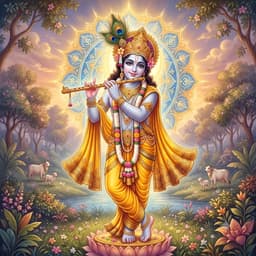
Krishna Mantra (Extended)
कृष्ण मंत्र (विस्तारित)
Deity: Lord Krishna
Source: Bhagavata Purana
Sanskrit (Devanagari)
ॐ कृष्णाय वासुदेवाय हरये परमात्मने। प्रणत क्लेशनाशाय गोविन्दाय नमो नमः।
Transliteration
Om Kṛṣṇāya Vāsudevāya Haraye Paramātmane Praṇata-Kleśa-Nāśāya Govindāya Namo Namaḥ
Meaning
Salutations to Lord Krishna, son of Vasudeva, Hari (remover of sorrows), the Supreme Soul who destroys the sufferings of those who surrender, and to Govinda (protector of cows and senses)
Significance
This extended Krishna prayer — "Om Kṛṣṇāya Vāsudevāya Haraye Paramātmane, Praṇata-Kleśa-Nāśāya Govindāya Namo Namaḥ" — gathers several beloved names of the Lord into one offering: Krishna, Vāsudeva, Hari, the Paramātman, the destroyer of His devotees' sorrows, and Govinda. Cherished in the Vaiṣṇava tradition alongside the sixteen-word mahā-mantra, each name turns the heart toward a facet of the divine, making it a complete prayer of refuge, devotion, and the longing for liberation.
Benefits
- Invokes many divine names of Krishna in a single heartfelt offering
- Believed to dissolve the sorrows and troubles of the surrendered devotee
- Awakens loving devotion (prema-bhakti) and deep inner surrender
- Soothes the mind, lifting grief, fear, and restlessness
- Strengthens a steady refuge in the Lord through daily practice
How to Chant
- Bathe and sit on a clean āsana before Krishna's image, spine upright
- Quieten the breath; offer a short prayer of refuge and, if you wish, light a lamp
- Chant the full verse slowly, letting each name — Krishna, Vāsudeva, Hari, Govinda — register in the heart
- Repeat as one round of 108 on a tulsī mālā, or in fewer attentive rounds
- End in a minute of stillness, surrendering your cares at the Lord's feet
Questions and Answers
What is the meaning of this extended Krishna mantra?
It bows again and again to Krishna — as Vāsudeva, as Hari, as the Supreme Soul (Paramātman), as the destroyer of His devotees' sorrows, and as Govinda. It is a prayer of refuge in the Lord's many names.
How is this different from the sixteen-word Hare Krishna maha-mantra?
The sixteen-word mahā-mantra (Hare Krishna Hare Krishna…) repeats the names Hare, Krishna, and Rāma. This verse instead strings together Krishna, Vāsudeva, Hari, Paramātman, and Govinda — both are loved Vaiṣṇava prayers of devotion.
How many times and when should it be chanted?
A round of 108 on a tulsī mālā is traditional; even 11 attentive repetitions are valued. The pre-dawn brāhma-muhūrta is ideal, and Ekādaśī and Janmāṣṭamī are especially auspicious.
Who can chant this Krishna mantra?
Anyone with sincerity and reverence may chant it — of any age, gender, or background. In the Vaiṣṇava path, heartfelt devotion is the only true qualification for chanting the Lord's names.
Which deity is it dedicated to and what does it do?
It is dedicated to Lord Krishna in His many aspects. Traditionally it deepens devotion, brings the mind to peace, and is chanted for refuge — to place one's sorrows and fears in the Lord's care.