

VedKosh.com
Mahabharata — Anushasana Parva (Ch. 149)
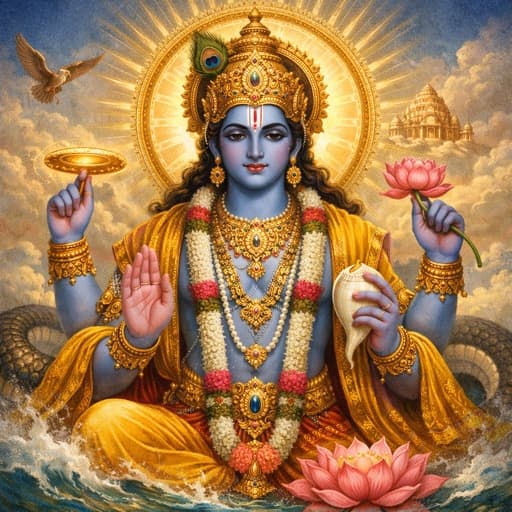
ॐ विश्वं विष्णुर्वषट्कारो भूतभव्यभवत्प्रभुः
Om Vishwam Vishnur-vashatkaaro Bhoota-bhavya-bhavat-prabhuh
"The universe is Vishnu — he is the lord of past, present, and future." — Names 1–4
1000
Names
108
Shlokas
13
Phala-shruti benefits
Bhishma
Speaker
After the Kurukshetra war, the great Bhishma Pitamaha lies on a bed of arrows, waiting for the auspicious Uttarayana to depart. Yudhishthira approaches him with a question: 'What single name satisfies all gods simultaneously?' Bhishma answers that there is only one such name — Narayana — and then proceeds to recite the 1000 names of Vishnu. This dialogue is preserved in the Anushasana Parva (Chapter 149) of the Mahabharata, transmitted by Vyasa.
Source
Mahabharata, Anushasana Parva (Ch. 149)
Speaker
Bhishma Pitamaha (on the arrow-bed)
Listener
Yudhishthira (King)
Total names
1000 (+8 opening slokas)
A few representative names grouped by theme — these are illustrative samplings, not the stotram’s own divisions. The complete 1000-name Sanskrit pāṭha (108 shlokas) is available on its own page — see the “Read the Full Text” button above.
Sanskrit etymology and philosophical significance
vis — to pervade
The very first name and the name of the entire scripture: Vishnu means 'the all-pervading one.' He is present in every atom, every thought, every breath. Not just a deity in a temple — but the substratum of all existence.
hrishika + isha — lord of senses
Hrishikesha is the name of Vishnu/Krishna used when Arjuna requests the Bhagavad Gita on the battlefield. It means 'lord of the senses' — he who controls both the physical senses and the cosmic forces that the senses represent. The name captures Vishnu's role as the inner guide and controller of all perception.
padma + nabha — lotus + navel
From Vishnu's navel, while he rests on Shesha Naga in the cosmic ocean (Yoga-nidra), a lotus emerges from which Brahma is born. This image — Ananta Shayana (eternal recliner) — is the most iconic depiction of Vishnu and is the icon of Padmanabhaswamy Temple (Trivandrum). Padmanabha is Vishnu as the originator of creation itself.
nara + ayana — goal/abode of souls
Narayana — the abode of all souls (nara = soul, ayana = refuge/abode). All living beings ultimately return to Narayana. This is also interpreted as 'one who moves on the waters' (nara = water, ayana = moving) — Vishnu as Ananta Shayana on the cosmic ocean. One of the most potent names, synonymous with Vishnu himself.
Key blessings described in the phala-shruti of the Anushasana Parva
Liberation from fear
Protection from enemies
Fulfillment of desires
Long life
Good progeny
Wealth and prosperity
Success in endeavors
Freedom from illness
Attainment of dharma, artha, kama, moksha
Victory in litigation
End of sorrows and difficulties
Safe childbirth and protection of children
Liberation (moksha) at death
Best day
Thursday (Guruvaar)
Time
Dawn or dusk preferred
Repetitions
1 full reading or 108x any one name
Special occasions
Ekadashi, Janmashtami, Vishnu vrat days
A simple six-step routine for daily recitation
Best time
Early morning 5:00–7:00 AM after a bath. Or on Thursday evening.
Direction & place
Sit facing East or North — before an image or idol of Vishnu.
Attire
Yellow or white clothes. Sit on an asana on the floor.
Pre-recitation
First read the purva-dhyāna śloka (Shuklāmbaradharaṃ); light incense and a lamp.
Main recitation
Recite the 1000 names — about 30–45 minutes; keep concentration steady.
Samarpaṇa
At the end, offer everything to Narayana with the samarpaṇa śloka (Kāyena vācā…).
Before recitation — Purva-dhyāna śloka
ॐ शुक्लाम्बरधरं विष्णुं शशिवर्णं चतुर्भुजम्।
प्रसन्नवदनं ध्यायेत् सर्वविघ्नोपशान्तये॥
ॐ विष्णवे नमः। ॐ विष्णवे नमः। ॐ विष्णवे नमः।
Phala (fruit) śloka
ॐ नमो भगवते वासुदेवाय
यस्य स्मरणमात्रेण जन्मसंसारबन्धनात्।
विमुच्यते नमस्तस्मै विष्णवे प्रभविष्णवे॥
After recitation — Samarpaṇa śloka
कायेन वाचा मनसेन्द्रियैर्वा
बुद्ध्यात्मना वा प्रकृतेः स्वभावात्।
करोमि यद्यत् सकलं परस्मै
नारायणायेति समर्पयामि॥
The Vishnu Sahasranamam is a sacred Hindu devotional hymn (stotram) dedicated to Vishnu. VedKosh provides its complete text in Hindi and English with transliteration for regional readers.
Reciting the Vishnu Sahasranamam with devotion is traditionally believed to invoke the grace of Vishnu, calm and focus the mind, and create an auspicious, sattvic atmosphere. It is practised as an act of bhakti (devotion) rather than for any guaranteed material outcome.
The Vishnu Sahasranamam can be recited during daily morning or evening worship of Vishnu, and especially on the deity's sacred days and festivals. A clean, quiet space and a steady, devotional mind are the main requirements.
विष्णु सहस्रनाम विष्णु को समर्पित एक पवित्र हिन्दू भक्ति स्तोत्र है। वेदकोश पर इसका पूर्ण पाठ हिंदी और अंग्रेज़ी में (क्षेत्रीय पाठकों हेतु लिप्यंतरण सहित) उपलब्ध है।
विष्णु सहस्रनाम का श्रद्धापूर्वक पाठ विष्णु की कृपा का आह्वान करता है, मन को शांत व एकाग्र करता है और शुभ, सात्विक वातावरण बनाता है। इसे किसी निश्चित भौतिक फल की गारंटी के रूप में नहीं, बल्कि भक्ति-भाव से किया जाता है।
विष्णु सहस्रनाम का पाठ विष्णु की प्रातः या संध्या पूजा में, तथा विशेषकर देवता के पवित्र दिनों व पर्वों पर किया जा सकता है। स्वच्छ, शांत स्थान और स्थिर भक्ति-भाव ही मुख्य आवश्यकता है।
Updated for 2026
2026 के लिए अद्यतन
Recently Accessed
Premium Tools
View All →Trending Topics
Explore related Hindu wisdom, daily guidance, and AI-powered answers on VedKosh.
Independently reviewed for authenticity. Please verify meanings and rituals yourself before following. Not medical, legal or financial advice.