← Stotram ListDashavatara — Ten Avatars of Lord Vishnu
Last updated: 14 June 2026
"Sambhavāmi yuge yuge" — I incarnate in every age to restore Dharma — Bhagavad Gita 4.8
यदा यदा हि धर्मस्य ग्लानिर्भवति भारत ।
अभ्युत्थानमधर्मस्य तदात्मानं सृजाम्यहम् ॥
Bhagavad Gita 4.7
"Whenever there is a decline in Dharma and a rise of Adharma, O Bharata — then I manifest Myself."
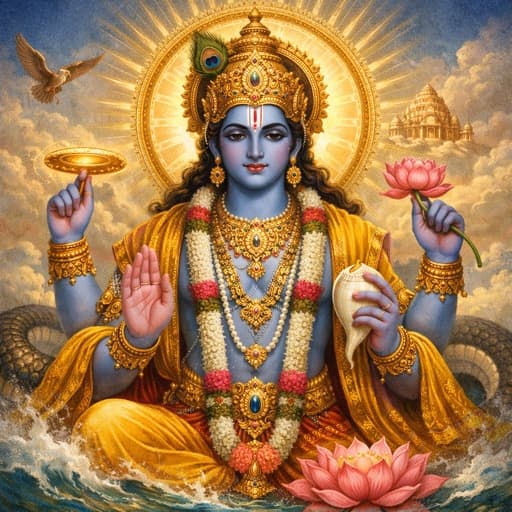
The Dashavatara are the ten principal incarnations (avatars) of Lord Vishnu — the Preserver in the Hindu Trimurthi — each descending at a critical juncture in cosmic history to protect Dharma and restore the balance of creation. From the aquatic Matsya to the future Kalki, the sequence mirrors the journey from primordial waters through land life to fully developed consciousness. Many scholars note a striking parallel with evolutionary theory — a profound expression of Sanatana Dharma's vision of cosmic time.
The Ten Avatars — Story & Significance
Story
Vishnu incarnated as a giant fish to save the sage Manu and the Vedas from a great cosmic flood (pralaya). He guided Manu's boat to safety, preserving all life and sacred knowledge for the new creation.
Spiritual Significance
Preservation of Dharmic knowledge across cosmic cycles; the archetype of salvation through divine guidance.
2Kurma
Tortoise — Satya Yuga
Story
Vishnu became a giant tortoise to support Mount Mandara on his back during the churning of the cosmic ocean (Samudra Manthan). Devas and Asuras churned the ocean using Vasuki the serpent as a rope, producing Amrita (nectar of immortality) and other divine gifts.
Spiritual Significance
Divine support as the stable foundation; Vishnu as the base of all cosmic activity.
Story
The demon Hiranyaksha seized the Earth (Bhudevi) and dragged her into the primordial ocean. Vishnu took the form of a cosmic boar, dove into the depths of the universe, slew Hiranyaksha, and lifted the Earth on his tusks, restoring her to her rightful place.
Spiritual Significance
Rescue of the Earth from demonic forces; Vishnu as protector of creation itself.
4Narasimha
Man-Lion — Satya Yuga
Story
The demon king Hiranyakashipu, who had gained a boon that he could not be killed by man or animal, day or night, inside or outside — was slain by Vishnu in the form of Narasimha (half-man, half-lion), at dusk, on the threshold of his palace, placing him on his lap.
Spiritual Significance
Divine protection of pure devotion (Prahlada); Vishnu transcends all conceptual limits to protect his bhaktas.
5Vamana
Dwarf Brahmin — Treta Yuga
Story
King Bali, through great penance, had conquered all three worlds. Vishnu appeared as a dwarf Brahmin boy and asked Bali for three paces of land. When granted, Vamana expanded to cosmic proportions — covering earth and heaven in two strides, and placing his foot on Bali's head for the third, pushing him to Patala.
Spiritual Significance
Dharma cannot be confined — a gentle request conceals divine omnipotence; true humility and surrender (as in Bali) is also honoured.
6Parashurama
Rama with the Axe — Treta Yuga
Story
When the Kshatriya warrior class grew arrogant and oppressed brahmins and the helpless, Vishnu incarnated as Parashurama, a brahmin warrior. He cleansed the earth of corrupt Kshatriya rulers twenty-one times over, restoring social order and protecting the Dharmic code.
Spiritual Significance
Divine correction of social adharma; the warrior-sage archetype that does not shrink from righteous force.
7Rama
The Ideal King — Treta Yuga
Story
Vishnu incarnated as Prince Rama to defeat the demon king Ravana who had abducted Sita, Rama's wife. Rama, the ideal son, husband, king, and friend, exemplified Maryada (righteous conduct) in every role. His story forms the Ramayana, composed by Valmiki.
Spiritual Significance
Rama Rajya — the ideal governance; the complete embodiment of Dharma in human form.
8Krishna
The All-Attractive — Dwapara Yuga
Story
Vishnu's eighth avatar, Krishna, is the speaker of the Bhagavad Gita and the central figure of the Mahabharata. His life — from the divine child of Gokul to the statesman of Kurukshetra — represents the fullest revelation of Dharma, Bhakti, Jnana, and Karma Yoga.
Spiritual Significance
The complete Purna Avatara — all 16 divine attributes (kala) fully manifest; author of the Bhagavad Gita.
9Buddha
The Enlightened — Kali Yuga
Story
In the Puranic tradition, Vishnu incarnated as Gautama Buddha to reform Vedic practice that had been corrupted — redirecting focus toward non-violence (ahimsa), compassion, and inner wisdom. This avatar is understood in the Hindu tradition as a divine reform, not a departure from Dharma.
Spiritual Significance
Divine compassion and the reform of ritual excess; integration of all paths under Dharma.
10Kalki
Destroyer of Filth (Future) — End of Kali Yuga
Future Avatar Story
The tenth and final avatar of the current cosmic cycle — yet to descend. At the end of Kali Yuga, when Dharma has collapsed entirely, Vishnu will appear as Kalki riding a white horse with a blazing sword, to destroy adharma and begin the next Satya Yuga.
Spiritual Significance
Cosmic restoration — the eternal cycle of creation, dissolution, and renewal; Vishnu as the guardian of cosmic time.
Quick Reference Table
| # | Avatar | Form | Yuga | Purpose |
|---|
| 1 | Matsya | Fish | Satya Yuga | Preservation of Dharmic knowledge across cosmic cycles; the … |
| 2 | Kurma | Tortoise | Satya Yuga | Divine support as the stable foundation; Vishnu as the base … |
| 3 | Varaha | Boar | Satya Yuga | Rescue of the Earth from demonic forces; Vishnu as protector… |
| 4 | Narasimha | Man-Lion | Satya Yuga | Divine protection of pure devotion (Prahlada); Vishnu transc… |
| 5 | Vamana | Dwarf Brahmin | Treta Yuga | Dharma cannot be confined — a gentle request conceals divine… |
| 6 | Parashurama | Rama with the Axe | Treta Yuga | Divine correction of social adharma; the warrior-sage archet… |
| 7 | Rama | The Ideal King | Treta Yuga | Rama Rajya — the ideal governance; the complete embodiment o… |
| 8 | Krishna | The All-Attractive | Dwapara Yuga | The complete Purna Avatara — all 16 divine attributes (kala)… |
| 9 | Buddha | The Enlightened | Kali Yuga | Divine compassion and the reform of ritual excess; integrati… |
| 10 | Kalki | Destroyer of Filth (Future) | End of Kali Yuga | Cosmic restoration — the eternal cycle of creation, dissolut… |