Aarti Kunj Bihari Ki (आरती कुंज बिहारी की)
Janmashtami, Govardhan Puja, daily evening puja in Vaishnava homes and ISKCON temples
About this Aarti
Aarti Kunj Bihari Ki is a melodious aarti vividly describing Lord Krishna's enchanting form and Vrindavan pastimes.
Janmashtami, Govardhan Puja, daily evening puja in Vaishnava homes and ISKCON temples
Significance & Importance
The Krishna Aarti, known as 'Aarti Kunj Bihari Ki,' is one of the most beloved devotional compositions in the Vaishnava tradition. Attributed to various saint-poets of the Bhakti movement, this aarti captures the enchanting beauty and divine playfulness of Lord Krishna in his iconic form as the flute-playing cowherd of Vrindavan.
Lord Krishna, the eighth avatar of Vishnu, holds a unique place in Hindu philosophy as both the supreme godhead and the intimate companion of his devotees. The Bhagavad Gita, where Krishna reveals the highest truths of dharma, karma, and devotion, makes him the most philosophically significant deity in Hinduism. Yet this aarti celebrates his other dimension — the divine child and romantic beloved who danced with the gopis in the moonlit groves (kunj) of Vrindavan.
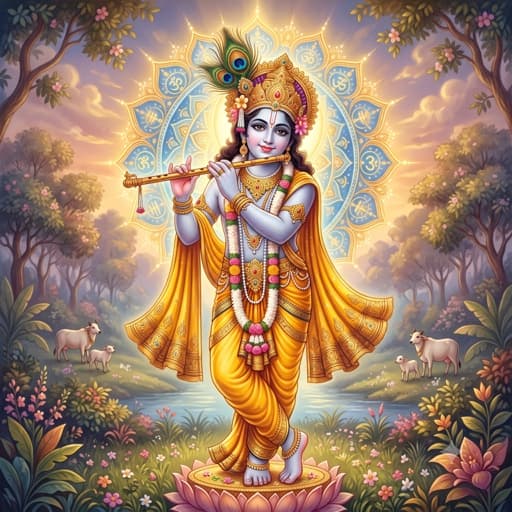
The aarti paints a vivid picture of Krishna's mesmerizing form: the Vaijayanti garland around his neck, the sweet melody of his flute, the glittering earrings, and his dark complexion that rivals the rain clouds. Radha, his eternal consort and the embodiment of devotional love (bhakti), shines beside him. This imagery is not merely decorative — in Vaishnava theology, Krishna's beauty is itself a manifestation of divine grace that draws the soul toward liberation.
This aarti is integral to daily worship in Krishna temples across Mathura, Vrindavan, Dwarka, and Puri. It is especially significant during Krishna Janmashtami (the celebration of Krishna's birth) and Holi, the festival of colors associated with Krishna's playful nature. The Rani Sati temple tradition and ISKCON movement have helped spread this aarti globally.
English Transliteration
Aarti Kunj Bihari Ki, Shri Giridhar Krishna Murari Ki.
Gale Mein Baijanti Mala, Bajawat Bansi Madhur Bala.
Shravan Mein Kundal Jhalkala, Nand Ke Anand Nandlala.
Gagan Sam Ang Kanti Kali, Radhika Chamak Rahi Aali.
Latan Mein Thaade Banmali, Bhramar Si Alak, Kasturi Tilak,
Chandra Si Jhalak, Lalit Chavi Shyama Pyari Ki.
Aarti Kunj Bihari Ki.

Kanakamay Mor Mukut Bilsain, Devata Darshan Ko Tarsain.
Gagan Se Suman Rasi Barsain, Baje Murchang, Madhur Mridang,
Gwalin Sang, Atul Rati Gop Kumari Ki.
Aarti Kunj Bihari Ki.

Jahan Te Prakat Bhai Ganga, Sakal Man Harini Shri Ganga.
Smaran Te Hot Moh Bhanga, Basi Shiv Sees, Jata Ke Bees,
Hare Jagdis, Patak Jari Ki.
Aarti Kunj Bihari Ki.

Chamakti Ujjwal Tat Renu, Baj Rahi Vrindavan Benu.
Chahun Dishi Gop Gwal Dhenu, Hansat Mridu Mand, Chandni Chand,
Katat Bhav Fand, Ter Sun Shyama Pyari Ki.
Aarti Kunj Bihari Ki.

Aarti Kunj Bihari Ki, Shri Giridhar Krishna Murari Ki.
Verse-by-Verse Meaning
Tap “Show meaning” under any line to read its bhāvārth.
Aarti Kunj Bihari Ki, Shri Giridhar Krishna Murari Ki.
Show meaningHide meaning
This is the aarti of Krishna who roams the bowers (kunj) of Vrindavan — He who is Giridhar, the lifter of Govardhan, and Murari, the slayer of the demon Mura. (This is the refrain, repeated throughout.)
Gale Mein Baijanti Mala, Bajawat Bansi Madhur Bala.
Show meaningHide meaning
A beautiful garland of Vaijayanti flowers adorns His neck, and He plays a sweet melody upon His flute.
Shravan Mein Kundal Jhalkala, Nand Ke Anand Nandlala.
Show meaningHide meaning
Earrings glimmer in His ears; He is Nandlala, the very joy of Nanda Baba.
Gagan Sam Ang Kanti Kali, Radhika Chamak Rahi Aali.
Show meaningHide meaning
The lustre of His limbs is dark like the sky (rain cloud), and beside Him His companion Radhika shines radiantly.
Latan Mein Thaade Banmali, Bhramar Si Alak, Kasturi Tilak,
Show meaningHide meaning
Wearing the forest-garland (vanmala), Krishna stands amid the flowering bowers; His curling locks are dark like a black bee, and a tilak of musk marks His forehead.
Chandra Si Jhalak, Lalit Chavi Shyama Pyari Ki.
Show meaningHide meaning
A moon-like glow plays upon His face — this is the enchanting image of dark-hued Krishna with His beloved Shyama (Radha).
Aarti Kunj Bihari Ki.
Show meaningHide meaning
(Refrain — repeated)
Kanakamay Mor Mukut Bilsain, Devata Darshan Ko Tarsain.
Show meaningHide meaning
A gold-bright peacock-feather crown shines upon His head; even the gods long for such a divine sight (darshan).
Gagan Se Suman Rasi Barsain, Baje Murchang, Madhur Mridang,
Show meaningHide meaning
From the sky a shower of flowers rains down (cast by the gods); the murchang (jaw-harp) and the sweet mridang drum resound.
Gwalin Sang, Atul Rati Gop Kumari Ki.
Show meaningHide meaning
He is in the company of the cowherd-women; the love of the gopa maidens of Vraja for Him is beyond compare.
Aarti Kunj Bihari Ki.
Show meaningHide meaning
(Refrain — repeated)
Jahan Te Prakat Bhai Ganga, Sakal Man Harini Shri Ganga.
Show meaningHide meaning
From Him (His feet, in His Vishnu form) the Ganga sprang forth — that holy Ganga who captivates every heart (and washes away all sin).
Smaran Te Hot Moh Bhanga, Basi Shiv Sees, Jata Ke Bees,
Show meaningHide meaning
By whose mere remembrance delusion (ignorance) is shattered; that same Ganga dwells upon Shiva's head, within the strands of His matted locks.
Hare Jagdis, Patak Jari Ki.
Show meaningHide meaning
That Lord of the universe (Jagdish) burns away and destroys the accumulated sins of His devotee.
Aarti Kunj Bihari Ki.
Show meaningHide meaning
(Refrain — repeated)
Chamakti Ujjwal Tat Renu, Baj Rahi Vrindavan Benu.
Show meaningHide meaning
The sand of the (Yamuna's) bank glistens bright, and the flute (venu) sounds melodiously through Vrindavan.
Chahun Dishi Gop Gwal Dhenu, Hansat Mridu Mand, Chandni Chand,
Show meaningHide meaning
In all four directions are cowherds and cows; Krishna smiles a soft, gentle smile, and the moon spreads its moonlight.
Katat Bhav Phand, Ter Sun Shyama Pyari Ki.
Show meaningHide meaning
Hearing the call of His beloved Shyama (Radha) He comes, and (by His remembrance) the noose of worldly bondage is severed for His devotees.
Aarti Kunj Bihari Ki.
Show meaningHide meaning
(Refrain — repeated)
Aarti Kunj Bihari Ki, Shri Giridhar Krishna Murari Ki.
Show meaningHide meaning
(Closing refrain) Thus concludes the aarti of Kunj Bihari Krishna — Giridhar and Murari.
More aartis you may love
Find an aarti by occasion
Frequently Asked Questions
When should the Aarti Kunj Bihari Ki be recited?
Janmashtami, Govardhan Puja, daily evening puja in Vaishnava homes and ISKCON temples
What are the benefits of reciting the Aarti Kunj Bihari Ki?
Reciting the Aarti Kunj Bihari Ki with devotion is traditionally believed to invoke the grace of Krishna, steady the mind, dispel negativity, and create an auspicious, sattvic atmosphere at home. It is offered as an act of bhakti (loving devotion) rather than for any guaranteed material result.
Where can I read the complete Aarti Kunj Bihari Ki lyrics?
VedKosh provides the complete Aarti Kunj Bihari Ki lyrics dedicated to Krishna (कृष्ण) in both Hindi and English (with transliteration for regional readers), along with its meaning and a printable/downloadable version.