

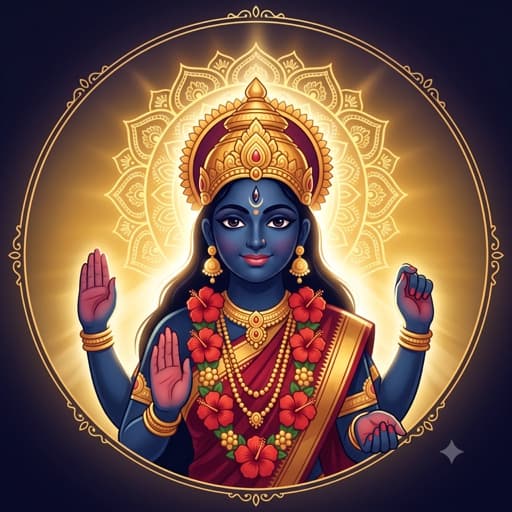
Kali Aarti (काली माता की आरती)
Significance & Importance
'Mangal Ki Seva' is the intimate devotional prayer to Goddess Kali — the fierce yet profoundly compassionate form of Adi Shakti — worshipped as destroyer of evil and ego, liberator of souls, and the loving mother whose infinite grace lies behind the terrifying visage.
Goddess Kali is one of the Dasha Mahavidyas (ten cosmic wisdom-forms of the Divine Mother) and is counted as Mahakali — the supreme power of time and transformation. In the Shakta tradition she is understood as a form of Durga and Parvati: the same divine feminine who in her most tranquil aspect is Gauri, and in her most fierce aspect is Kali. Her dark complexion represents the infinite void beyond creation; her garland of heads symbolizes the dissolution of the ego and the severing of the cycle of false identity; the Devi Mahatmya describes her as the force that rises from Durga's concentrated fury to vanquish what no lesser power can overcome.
The aarti opens at her very threshold: 'Mangal ki seva sun meri deva, haath jod tere dwaar khade' — devotees stand with folded hands offering pan, supari, flag, and coconut. This image captures the heart of Kali worship — direct, unmediated, trusting. The hymn then invokes her as Buddhi Vidhata and Jagdamba, affirming that behind the terrifying exterior lies infinite maternal grace that has repeatedly rushed to the protection of her devotees in moments of peril.
Goddess Kali is pre-eminently venerated at the Kalighat temple in Kolkata and the Dakshineshwar temple on the Hooghly. Kali Puja, observed on the new-moon night of Kartik, is the greatest festival of her worship in West Bengal, where her aarti fills neighborhoods through the night. Devotees seek fearlessness (abhaya), protection, dissolution of sin, and the liberation that comes when the ego's illusions are finally cut away.
English Transliteration
Mangal Ki Seva Sun Meri Deva, Haath Jod Tere Dwaar Khade.
Paan Supari Dhwaja Nariyal Le Jwala Teri Bhent Dhare.

Sun Jagdambe Kar Na Vilambe, Santan Ke Bhandaar Bhare.
Santan Pratipali Sada Khushhali, Maiya Jai Kali Kalyaan Kare.

Buddhi Vidhata Tu Jag Mata, Mera Kaaraj Siddh Kare.
Charan Kamal Ka Liya Aasra, Sharan Tumhari Aan Pade.

Jab Jab Bheed Padi Bhaktan Par, Tab Tab Aay Sahay Kare.
Santan Pratipali Sada Khushhali, Maiya Jai Kali Kalyaan Kare.

Guru Ke Vaar Vaarik Jeeve, Paapharani Tar Jaave.
Kahe Sevak Tera Charan Chhue Jo, Manvaanchhit Phal Paave.

Santan Pratipali Sada Khushhali, Maiya Jai Kali Kalyaan Kare.
Mangal Ki Seva Sun Meri Deva, Haath Jod Tere Dwaar Khade.
Verse-by-Verse Meaning
Tap “Show meaning” under any line to read its bhāvārth.
Mangal Ki Seva Sun Meri Deva, Haath Jod Tere Dwaar Khade. / Paan Supari Dhwaja Nariyal Le Jwala Teri Bhent Dhare.
Show meaningHide meaning
O my Goddess (Mother Kali), accept this auspicious worship-service; with folded hands I stand at your door. Bringing betel leaf, areca nut, a flag (banner) and a coconut, and kindling a sacred flame, I lay these offerings before you. (This is the opening refrain — it returns again at the end.)
Sun Jagdambe Kar Na Vilambe, Santan Ke Bhandaar Bhare. / Santan Pratipali Sada Khushhali, Maiya Jai Kali Kalyaan Kare.
Show meaningHide meaning
O Mother of the universe (Jagadamba), hear my call, do not delay, and fill the storehouses (treasuries) of your devotees and saints. You are the protector of the saints and the ever-giver of happiness and prosperity — glory to you, Mother Kali; may you bring everyone's welfare. (This second line is the recurring refrain.)
Buddhi Vidhata Tu Jag Mata, Mera Kaaraj Siddh Kare. / Charan Kamal Ka Liya Aasra, Sharan Tumhari Aan Pade.
Show meaningHide meaning
You are the bestower of intellect, the divine creator, and the mother of the whole world; accomplish my task successfully. I have taken refuge at your lotus-like feet and have come to surrender at your shelter.
Jab Jab Bheed Padi Bhaktan Par, Tab Tab Aay Sahay Kare. / Santan Pratipali Sada Khushhali, Maiya Jai Kali Kalyaan Kare.
Show meaningHide meaning
Whenever hardship (calamity) has befallen your devotees, each time you come and render them help. (The next line is the refrain — repeated.)
Guru Ke Vaar Vaarik Jeeve, Paapharani Tar Jaave. / Kahe Sevak Tera Charan Chhue Jo, Manvaanchhit Phal Paave.
Show meaningHide meaning
One who worships you (especially on Thursday) lives sheltered and at ease in your care; O remover of sins, the soul thereby crosses over the ocean of worldly existence. Your servant declares: whoever touches your feet obtains the fruit desired in their heart.
Santan Pratipali Sada Khushhali, Maiya Jai Kali Kalyaan Kare. / Mangal Ki Seva Sun Meri Deva, Haath Jod Tere Dwaar Khade.
Show meaningHide meaning
(Both lines are the refrain and the opening verse — repeated once more to close the aarti.)
More aartis you may love
Find an aarti by occasion
Frequently Asked Questions
When should the Kali Aarti be recited?
The Kali Aarti is traditionally sung during the morning and evening aarti of Kali, and especially on days and festivals dedicated to Kali. It may be recited on any day with devotion.
What are the benefits of reciting the Kali Aarti?
Reciting the Kali Aarti with devotion is traditionally believed to invoke the grace of Kali, steady the mind, dispel negativity, and create an auspicious, sattvic atmosphere at home. It is offered as an act of bhakti (loving devotion) rather than for any guaranteed material result.
Where can I read the complete Kali Aarti lyrics?
VedKosh provides the complete Kali Aarti lyrics dedicated to Kali (काली) in both Hindi and English (with transliteration for regional readers), along with its meaning and a printable/downloadable version.