Surya Aarti (सूर्य जी की आरती)
Significance & Importance
The Surya Aarti, opening with 'Jai Kashyap-Nandan, Om Jai Aditi-Nandan,' honours the sun-god — son of Kashyapa and Aditi — as the visible face of the divine, dispeller of ignorance, and eternal source of light, health, and knowledge for all living beings.
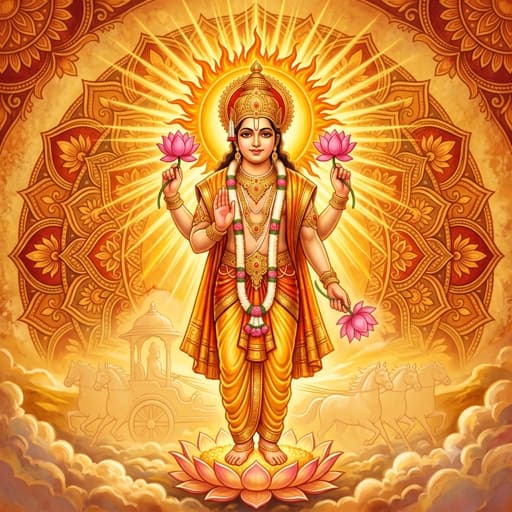
In the Vedic cosmos, Surya rides a golden chariot drawn by seven horses, each said to represent one of the seven colours of light or the seven days of the week, with Aruna serving as his charioteer. This imagery conveys both his cosmic sovereignty and his role as the measurer of time. Daily sunrise rituals such as Surya Namaskar and the offering of Arghya (water oblation at dawn) are among the most ancient devotional practices in Hinduism, kept alive in millions of households across the subcontinent.
The lyric of this aarti moves from praise to petition — asking Surya Dev to cure afflictions of the eyes, relieve the suffering of the earth, and, above all, dispel the veils of ignorance and delusion (agyan and moh) and grant true knowledge (tattvagyan). This makes the Surya aarti not merely a hymn of gratitude for physical light but a prayer for inner illumination — an aspiration deeply embedded in the Gayatri, arguably the most sacred verse of the Vedas, which is also addressed to Surya as the divine inspirer of the intellect.
Devotees perform this aarti with particular fervour during Chhath Puja — a four-day festival unique in being the only Vedic festival where the setting sun is also worshipped — as well as on Ratha Saptami (the seventh day of Magha) which marks the sun's northward journey, and Makar Sankranti, when the sun enters Capricorn and the harvest season begins. The great sun temples at Konark in Odisha and Modhera in Gujarat stand as architectural testimonies to the depth of Surya worship in Indian civilisation.
English Transliteration
Jai Kashyap-Nandan, Om Jai Aditi-Nandan.
Tribhuvantimirnikandan Bhakthriday Chandan. Tek.

Vishwavilochan Mochan Bhavbandhan Bhari.
Om Jai Kashyap-Nandan.
Om Jai Aditi-Nandan.

Kamalsamooh Vikashak Nashak Rog Tapa.
Sevat Sahaj Harat Ati Mansij Santapa.
Om Jai Kashyap-Nandan.
Om Jai Aditi-Nandan.

Netra Vyadhihar Survar Bhu-Peedahari.
Vrishtivimochan Santat Parhit Vratdhari.
Om Jai Kashyap-Nandan.
Om Jai Aditi-Nandan.

Suryadev Karunakar Ab Karuna Keejai.
Har Agyaan Moh Sab Tattvagyaan Deejai.
Om Jai Kashyap-Nandan.
Om Jai Aditi-Nandan.
Verse-by-Verse Meaning
Tap “Show meaning” under any line to read its bhāvārth.
Jai Kashyap-Nandan, Om Jai Aditi-Nandan. Tribhuvantimirnikandan Bhakthriday Chandan. (Tek/Refrain)
Show meaningHide meaning
Victory to you, O son of the sage Kashyapa, O son of mother Aditi (Surya Dev). You are the destroyer of the darkness of the three worlds, and like sandalwood you bring coolness and fragrance to the hearts of your devotees. (This is the refrain — repeated throughout.)
Vishwavilochan Mochan Bhavbandhan Bhari.
Show meaningHide meaning
You are the eye of the entire universe (the giver of light and sight), and the liberator who frees us from the heavy bonds of worldly existence.
Om Jai Kashyap-Nandan. Om Jai Aditi-Nandan.
Show meaningHide meaning
(Refrain repeats.)
Kamalsamooh Vikashak Nashak Rog Tapa. Sevat Sahaj Harat Ati Mansij Santapa.
Show meaningHide meaning
You cause clusters of lotuses to bloom — reviving the lotuses that close in the night — and you destroy disease and burning affliction. For the devotee who serves you, you effortlessly remove the intense torment born in the mind (the agitation and pain of inner passions).
Om Jai Kashyap-Nandan. Om Jai Aditi-Nandan.
Show meaningHide meaning
(Refrain repeats.)
Netra Vyadhihar Survar Bhu-Peedahari. Vrishtivimochan Santat Parhit Vratdhari.
Show meaningHide meaning
O best among the gods! You remove ailments of the eyes and relieve the suffering of the earth. You release the rains, and you ever observe the vow of working for the welfare of others.
Om Jai Kashyap-Nandan. Om Jai Aditi-Nandan.
Show meaningHide meaning
(Refrain repeats.)
Suryadev Karunakar Ab Karuna Keejai. Har Agyaan Moh Sab Tattvagyaan Deejai.
Show meaningHide meaning
O Surya Dev, ocean of compassion! Now bestow your mercy upon me. Remove all my ignorance and delusion, and grant me true knowledge of reality (tattva-jnana).
Om Jai Kashyap-Nandan. Om Jai Aditi-Nandan.
Show meaningHide meaning
(Refrain repeats.)
More aartis you may love
Find an aarti by occasion
Frequently Asked Questions
When should the Surya Aarti be recited?
The Surya Aarti is traditionally sung during the morning and evening aarti of Surya, and especially on days and festivals dedicated to Surya. It may be recited on any day with devotion.
What are the benefits of reciting the Surya Aarti?
Reciting the Surya Aarti with devotion is traditionally believed to invoke the grace of Surya, steady the mind, dispel negativity, and create an auspicious, sattvic atmosphere at home. It is offered as an act of bhakti (loving devotion) rather than for any guaranteed material result.
Where can I read the complete Surya Aarti lyrics?
VedKosh provides the complete Surya Aarti lyrics dedicated to Surya (सूर्य) in both Hindi and English (with transliteration for regional readers), along with its meaning and a printable/downloadable version.