Ram Aarti (राम की आरती)
Significance & Importance
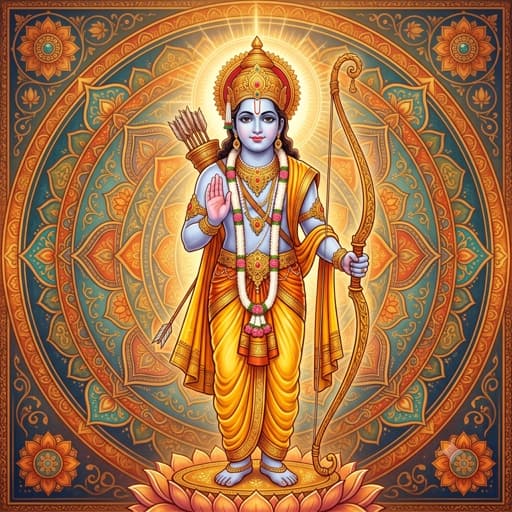
'Aarti Keejai Shri Raghuvar Ji Ki' is the most philosophically elevated Ram devotional hymn, opening with 'Sachchidananda Shiv Sundar Ki' — recognizing Lord Ram as eternal Brahman, the seventh avatar of Vishnu, revered as Maryada Purushottam and embodiment of dharma.
Lord Ram, son of King Dasharatha and Queen Kaushalya of Ayodhya, is revered as Maryada Purushottam — the supreme exemplar of righteous conduct, duty, and truth. The Ramayana chronicles his life as the perfect fulfillment of dharma across every role: the ideal son who honored his father's word at the cost of his throne, the ideal husband who crossed oceans for Sita, the ideal king whose reign became synonymous with justice and abundance, and the ideal friend whose bond with Hanuman exemplifies devotion reciprocated with grace.
This aarti honors both Ram's transcendent and immanent aspects. 'Nirgun, Sagun, Anoop Roop Nidhi' affirms that he is at once the attributeless Brahman (nirgun) and a beautiful human form (sagun avatar) — a philosophical reconciliation central to the Bhakti tradition. The hymn celebrates him as 'Janaki Pati Sur Adhipati Jagpati' — lord of Sita, lord of the gods, and lord of the universe — and as the sole refuge of all creation, moving and unmoving alike.
This aarti is sung on Ram Navami (Chaitra Shukla Navami), on Diwali — commemorating Ram's return to Ayodhya after fourteen years of exile — and on Vijayadashami. It resounds through Ayodhya's temples and the entire Hindi-speaking heartland. The tradition holds the very name 'Ram' to be a mantra of purification — 'Naam let jag paavan kaari' — and this aarti makes that truth its devotional cornerstone.
English Transliteration
Aarti Keejai Shri Raghuvar Ji Ki,
Sachchidanand Shiv Sundar Ki,

Dashrath Tanay Kaushalya Nandan,
Sur, Muni, Rakshak, Daitya Nikandan,
Anugat Bhakt-Bhakt Ur Chandan,
Maryada Purushottam Var Ki,
Aarti Keejai Shri...

Nirgun, Sagun, Anoop Roop Nidhi,
Sakal Lok Vandit Vibhinn Vidhi,
Haran Shok Bhaydayak Navnidhi,
Maya Rahit Divya Nar Var Ki,
Aarti Keejai Shri...

Janaki Pati Sur Adhipati Jagpati,
Akhil Lok Palak Trilok Gati,
Vishwa Vandya Avyay Amit Gati,
Ek Matra Gati Sacharachar Ki,
Aarti Keejai Shri...

Sharnagati Vatsal Vratdhari,
Bhakt Kalp Taruvar Asurari,
Naam Let Jag Paavan Kari,
Vanar Sakha Deen Dukh Har Ki,
Aarti Keejai Shri...
Verse-by-Verse Meaning
Tap “Show meaning” under any line to read its bhāvārth.
Aarti Keejai Shri Raghuvar Ji Ki, Sachchidanand Shiv Sundar Ki
Show meaningHide meaning
Come, let us perform the aarti of Shri Ram, the noblest of the Raghu dynasty — who is the embodiment of Existence-Consciousness-Bliss (Sat-Chit-Ananda), all-auspicious (Shiva), and supremely beautiful. (This is the refrain, repeated at the close of every verse.)
Dashrath Tanay Kaushalya Nandan, Sur, Muni, Rakshak, Daitya Nikandan
Show meaningHide meaning
He who is the son of King Dasharatha and the beloved child of mother Kaushalya; protector of the gods and sages, and destroyer of the demons.
Anugat Bhakt-Bhakt Ur Chandan, Maryada Purushottam Var Ki
Show meaningHide meaning
He who is benevolent to His devoted followers and, like sandalwood, brings coolness and fragrance to His devotees' hearts; the ideal upholder of righteous conduct (Maryada Purushottam) and the most excellent of all — let us perform His aarti.
Aarti Keejai Shri...
Show meaningHide meaning
(refrain repeats)
Nirgun, Sagun, Anoop Roop Nidhi, Sakal Lok Vandit Vibhinn Vidhi
Show meaningHide meaning
He who is both formless (Nirguna) and with form (Saguna); the treasure-house of incomparable beauty; whom all the worlds adore in countless different ways.
Haran Shok Bhaydayak Navnidhi, Maya Rahit Divya Nar Var Ki
Show meaningHide meaning
He who dispels both sorrow and fear, and bestows the nine treasures (Navnidhi); who is beyond illusion (Maya), divine, and the foremost among men — let us perform His aarti.
Aarti Keejai Shri...
Show meaningHide meaning
(refrain)
Janaki Pati Sur Adhipati Jagpati, Akhil Lok Palak Trilok Gati
Show meaningHide meaning
He who is the lord of Janaki (Sita), the master of the gods, and the lord of the entire universe; the sustainer of all the worlds and the sole refuge (goal) of the three realms.
Vishwa Vandya Avyay Amit Gati, Ek Matra Gati Sacharachar Ki
Show meaningHide meaning
He who is worshipped by the whole world, imperishable, and of boundless might; the one and only refuge and ultimate goal of all creation, moving and unmoving — let us perform His aarti.
Aarti Keejai Shri...
Show meaningHide meaning
(refrain)
Sharnagati Vatsal Vratdhari, Bhakt Kalp Taruvar Asurari
Show meaningHide meaning
He who has taken the vow of tender affection toward all who seek His shelter; who is like the wish-fulfilling tree (Kalpavriksha) for His devotees and the enemy (slayer) of the demons.
Naam Let Jag Paavan Kari, Vanar Sakha Deen Dukh Har Ki
Show meaningHide meaning
He whose very name, when uttered, purifies the whole world; the friend of the vanaras (Hanuman and others) and the remover of the suffering of the humble and distressed — let us perform the aarti of that Shri Ram.
Aarti Keejai Shri...
Show meaningHide meaning
(refrain)
More aartis you may love
Find an aarti by occasion
Frequently Asked Questions
When should the Ram Aarti be recited?
The Ram Aarti is traditionally sung during the morning and evening aarti of Ram, and especially on days and festivals dedicated to Ram. It may be recited on any day with devotion.
What are the benefits of reciting the Ram Aarti?
Reciting the Ram Aarti with devotion is traditionally believed to invoke the grace of Ram, steady the mind, dispel negativity, and create an auspicious, sattvic atmosphere at home. It is offered as an act of bhakti (loving devotion) rather than for any guaranteed material result.
Where can I read the complete Ram Aarti lyrics?
VedKosh provides the complete Ram Aarti lyrics dedicated to Ram (राम) in both Hindi and English (with transliteration for regional readers), along with its meaning and a printable/downloadable version.