Shani Aarti (शनि देव की आरती)
Significance & Importance
'Jai Jai Shri Shanidev Bhaktan Hitkari' is the central devotional hymn dedicated to Lord Shani — son of Surya and Chhaya — the presiding deity of Saturday and the cosmic dispenser of karmic justice, patience, and disciplined inner growth in the Vedic tradition.
Lord Shani is the adhipati (lord) of Saturday and the slowest-moving of the nine grahas recognized in Vedic astrology. As the cosmic dispenser of karma-phala, he does not punish arbitrarily: according to tradition, he ensures that every soul receives the precise consequences of its own deeds, teaching endurance and wisdom through that process. He is the brother of Yama — lord of righteous order — which underscores his role as an upholder of dharmic law rather than an agent of fear.
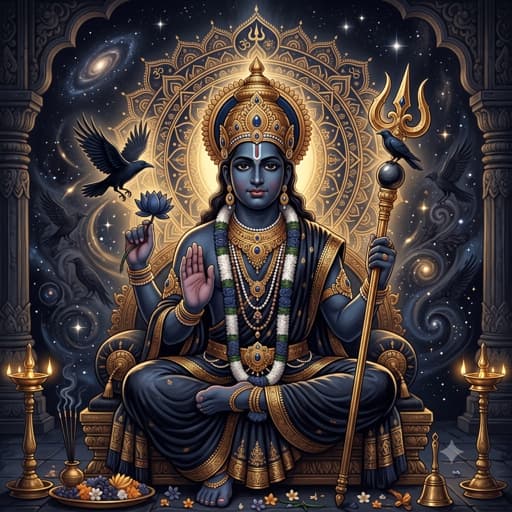
The aarti describes his distinctive iconography with reverence: a dark-hued (shyam) four-armed form with a penetrating gaze (vakra drishti), dressed in blue-black attire (Nilambar), his mount the crow and his vehicle an iron chariot, crowned with a jewelled diadem, and garlanded with pearls. These attributes carry symbolic depth: his dark coloring and measured movement represent the inexorable yet fair progression of time and consequence; his crow and his slow, deliberate motion evoke the patient, inescapable working-out of karma over time. Sesame, mustard oil, iron, and black urad dal are offered to him on Saturdays.
Devotees observe Shani Jayanti, perform Shani Puja on Saturdays, and light sesame-oil lamps at temples such as Shingnapur and Tirunallar. The periods of Sade Sati and Dhaiya are traditionally held to be times of testing that ultimately refine the soul. This aarti is a prayer of surrender and trust — acknowledging that Shani's discipline is ultimately in service of the devotee's highest growth.
English Transliteration
Jai Jai Shri Shanidev Bhaktan Hitkari.
Suraj Ke Putra Prabhu, Chhaya Mahtari.

Shyam Ang Vakra Drishti Chaturbhuja Dhari.
Nilambar Dhaar Nath, Gaj Ki Aswari.

Kireet Mukut Sheesh Rajit, Deepat Hai Lilari.
Muktan Ki Mala Gale, Shobhit Balihari.

Modak Mishthaan Paan, Chadhat Hain Supaari.
Loha Til Tel Urad, Mahishi Ati Pyari.

Dev Danuj Rishi Muni, Sumirat Nar Nari.
Vishwanath Dharat Dhyan, Sharan Hai Tumhari.

Jai Jai Shri Shanidev Bhaktan Hitkari.
Suraj Ke Putra Prabhu, Chhaya Mahtari.
Verse-by-Verse Meaning
Tap “Show meaning” under any line to read its bhāvārth.
Jai Jai Shri Shanidev Bhaktan Hitkari. Suraj Ke Putra Prabhu, Chhaya Mahtari.
Show meaningHide meaning
Victory, victory to you, O Shri Shani Dev, ever the well-wisher and benefactor of your devotees! O Lord, you are the son of Surya (the Sun God), and Chhaya (Devi) is your mother.
Shyam Ang Vakra Drishti Chaturbhuja Dhari. Nilambar Dhaar Nath, Gaj Ki Aswari.
Show meaningHide meaning
Your body is dark-hued (shyam), your gaze is sidelong (vakra), and you bear four arms. O Lord, you wear blue garments and ride upon an elephant (gaj).
Kireet Mukut Sheesh Rajit, Deepat Hai Lilari. Muktan Ki Mala Gale, Shobhit Balihari.
Show meaningHide meaning
A resplendent crown and diadem adorn your head, and your brow (lilar/forehead) shines beneath it. With a garland of pearls around your neck you look most glorious — I offer myself in devotion to you.
Modak Mishthaan Paan, Chadhat Hain Supaari. Loha Til Tel Urad, Mahishi Ati Pyari.
Show meaningHide meaning
Modak (sweet dumplings), sweets, betel-leaf (paan) and betel-nut (supari) are offered to you. Iron (loha), sesame (til), oil (tel), black gram (urad) and the buffalo (mahishi) are exceedingly dear to you.
Dev Danuj Rishi Muni, Sumirat Nar Nari. Vishwanath Dharat Dhyan, Sharan Hai Tumhari.
Show meaningHide meaning
Gods, demons, sages and ascetics, and all men and women remember and invoke you. Even Vishwanath (Lord Shiva) meditates upon you; O Lord, I take refuge in you.
Jai Jai Shri Shanidev Bhaktan Hitkari. Suraj Ke Putra Prabhu, Chhaya Mahtari.
Show meaningHide meaning
(refrain / repeated)
More aartis you may love
Find an aarti by occasion
Frequently Asked Questions
When should the Shani Aarti be recited?
The Shani Aarti is traditionally sung during the morning and evening aarti of Shani, and especially on days and festivals dedicated to Shani. It may be recited on any day with devotion.
What are the benefits of reciting the Shani Aarti?
Reciting the Shani Aarti with devotion is traditionally believed to invoke the grace of Shani, steady the mind, dispel negativity, and create an auspicious, sattvic atmosphere at home. It is offered as an act of bhakti (loving devotion) rather than for any guaranteed material result.
Where can I read the complete Shani Aarti lyrics?
VedKosh provides the complete Shani Aarti lyrics dedicated to Shani (शनि) in both Hindi and English (with transliteration for regional readers), along with its meaning and a printable/downloadable version.