Jai Ambe Gauri Aarti (जय अम्बे गौरी)
Navratri (Chaitra and Sharad), evening puja, Fridays
About this Aarti
Jai Ambe Gauri is one of the most popular Navratri aartis, sung in praise of Goddess Durga in her radiant golden form.
Navratri (Chaitra and Sharad), evening puja, Fridays
Significance & Importance
The Durga Aarti, 'Jai Ambe Gauri,' is the central devotional hymn of Shakti worship in Hinduism and holds immense significance during the nine nights of Navratri — the most important festival dedicated to the Divine Mother. Goddess Durga, whose name means 'the invincible one,' represents the primordial feminine energy (Shakti) that sustains and protects the cosmos.
According to the Devi Mahatmya (also known as Durga Saptashati), when the demons Mahishasura threatened to overthrow the gods and plunge the universe into darkness, the combined radiance of all the gods manifested as Goddess Durga. Armed with divine weapons from each deity — Shiva's trident, Vishnu's discus, Indra's thunderbolt — she vanquished Mahishasura in a cosmic battle, restoring dharma and cosmic order.
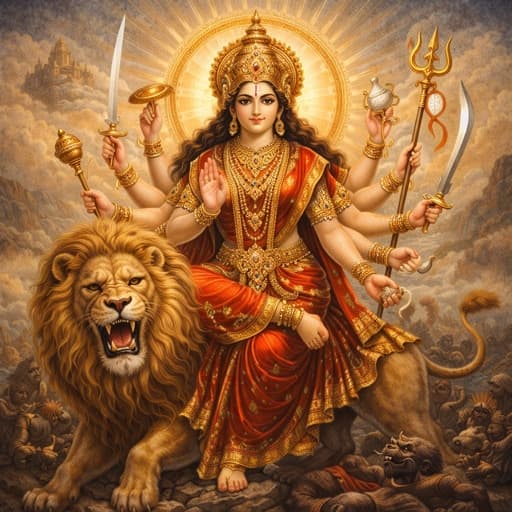
This aarti addresses Durga as 'Ambe Gauri' — the mother who is both fierce protector and gentle nurturer. The hymn describes her arrival on a lion, symbolizing courage and sovereignty, and her manifestation in forms ranging from Mahalakshmi (prosperity) to Mahakali (destruction of evil). The four arms represent dharma, wealth, desire, and liberation — the four goals of human life.
During Navratri, millions of devotees across India perform this aarti twice daily — at dawn and dusk — for nine consecutive nights. The festival's nine nights honor nine forms of Durga (Navadurga), with the tenth day (Vijayadashami/Dussehra) celebrating her ultimate victory. In West Bengal, the same celebration takes the form of Durga Puja, a UNESCO-recognized cultural heritage tradition. This aarti connects devotees to the empowering truth that the supreme divine force is feminine — the Mother who both creates and protects.
English Transliteration
Jai Ambe Gauri, Maiya Jai Shyama Gauri.
Tumko Nishdin Dhyavat, Hari Brahma Shiv Ji.
Jai Ambe Gauri.

Maang Sindoor Virajat, Teeko Mrigmad Ko.
Ujjwal Se Do Naina, Chandravadan Neeko.
Jai Ambe Gauri.

Kanak Samaan Kalevar, Raktambar Rajai.
Rakt Pushp Gal Mala, Kanthan Par Sajai.
Jai Ambe Gauri.

Kehari Vaahan Raajat, Khadg Khappar Dhari.
Sur-Nar-Muni-Jan Sevat, Tinke Dukh Hari.
Jai Ambe Gauri.

Kanan Kundal Shobhit, Nasagre Moti.
Kotik Chandra Divakar, Sam Raajat Jyoti.
Jai Ambe Gauri.

Shumbh-Nishumbh Bidaare, Mahishasur Ghati.
Dhoomra Vilochan Naina, Nishdin Madmati.
Jai Ambe Gauri.

Chand-Mund Sanhaare, Shonit Beej Hare.
Madhu-Kaitabh Dou Maare, Sur Bhayaheen Kare.
Jai Ambe Gauri.

Brahmani, Rudrani, Tum Kamla Rani.
Aagam Nigam Bakhani, Tum Shiv Patrani.
Jai Ambe Gauri.

Chaunsath Yogini Gaavat, Nritya Karat Bhairu.
Baajat Taal Mridanga, Aru Baajat Damru.
Jai Ambe Gauri.

Tum Hi Jag Ki Mata, Tum Hi Ho Bharta.
Bhaktan Ki Dukh Harta, Sukh Sampatti Karta.
Jai Ambe Gauri.

Bhuja Chaar Ati Shobhit, Var Mudra Dhari.
Manvaanchhit Phal Paavat, Sevat Nar Nari.
Jai Ambe Gauri.

Kanchan Thaal Virajat, Agar Kapoor Bati.
Shri Malketu Mein Raajat, Koti Ratan Jyoti.
Jai Ambe Gauri.

Shri Ambe Ji Ki Aarti, Jo Koi Nar Gaave.
Kahat Shivanand Swami, Sukh Sampatti Paave.
Jai Ambe Gauri.
Verse-by-Verse Meaning
Tap “Show meaning” under any line to read its bhāvārth.
Jai Ambe Gauri, Maiya Jai Shyama Gauri / Tumko Nishdin Dhyavat, Hari Brahma Shiv Ji
Show meaningHide meaning
Glory to you, O Mother Ambe of fair complexion; glory to you, O dark-hued Gauri Mother. Vishnu (Hari), Brahma and Shiva all meditate upon you ceaselessly, day and night. ("Jai Ambe Gauri" is the refrain, repeated after every stanza.)
Maang Sindoor Virajat, Teeko Mrigmad Ko / Ujjwal Se Do Naina, Chandravadan Neeko
Show meaningHide meaning
Sindoor graces the parting of your hair, and a tilak of musk (mrigmad) adorns your forehead. Your two eyes are radiantly bright, and your moon-like face (chandravadan) is exquisitely beautiful.
Jai Ambe Gauri
Show meaningHide meaning
(refrain)
Kanak Samaan Kalevar, Raktambar Rajai / Rakt Pushp Gal Mala, Kanthan Par Sajai
Show meaningHide meaning
Your form (kalevar) shines like gold (kanak), and you are resplendent in red garments (raktambar). A garland of red flowers adorns your throat and graces your neck.
Jai Ambe Gauri
Show meaningHide meaning
(refrain)
Kehari Vaahan Raajat, Khadg Khappar Dhari / Sur-Nar-Muni-Jan Sevat, Tinke Dukh Hari
Show meaningHide meaning
You ride gloriously upon a lion (kehari), bearing a sword (khadg) and a skull-cup (khappar). Gods, humans and sages all serve you, and you are the remover of all their sorrows.
Jai Ambe Gauri
Show meaningHide meaning
(refrain)
Kanan Kundal Shobhit, Nasagre Moti / Kotik Chandra Divakar, Sam Raajat Jyoti
Show meaningHide meaning
Earrings (kundal) adorn your ears and a pearl glistens at the tip of your nose. Your radiance shines like the light of millions (koti) of moons and suns (divakar).
Jai Ambe Gauri
Show meaningHide meaning
(refrain)
Shumbh-Nishumbh Bidaare, Mahishasur Ghati / Dhoomra Vilochan Naina, Nishdin Madmati
Show meaningHide meaning
You destroyed the demons Shumbha and Nishumbha and slew Mahishasura. You also vanquished Dhumralochana; your eyes ever shine, day and night, with intense fervour.
Jai Ambe Gauri
Show meaningHide meaning
(refrain)
Chand-Mund Sanhaare, Shonit Beej Hare / Madhu-Kaitabh Dou Maare, Sur Bhayaheen Kare
Show meaningHide meaning
You slew the demons Chanda and Munda and destroyed Raktabija (Shonit-Beej). Having killed both Madhu and Kaitabha, you freed the gods from all fear.
Jai Ambe Gauri
Show meaningHide meaning
(refrain)
Brahmani, Rudrani, Tum Kamla Rani / Aagam Nigam Bakhani, Tum Shiv Patrani
Show meaningHide meaning
You are Brahmani, Rudrani, and Queen Kamala (Lakshmi). The scriptures and Vedas (aagam-nigam) extol your glory; you are the supreme consort (patrani) of Shiva.
Jai Ambe Gauri
Show meaningHide meaning
(refrain)
Chaunsath Yogini Gaavat, Nritya Karat Bhairu / Baajat Taal Mridanga, Aru Baajat Damru
Show meaningHide meaning
The sixty-four Yoginis sing your praises and Bhairava dances before you. Cymbals (taal) and the mridanga drum sound forth, and the damaru too resounds.
Jai Ambe Gauri
Show meaningHide meaning
(refrain)
Tum Hi Jag Ki Mata, Tum Hi Ho Bharta / Bhaktan Ki Dukh Harta, Sukh Sampatti Karta
Show meaningHide meaning
You alone are the Mother of the world, and you alone are its sustainer (bharta). You are the remover of your devotees' sorrows and the giver of happiness and prosperity.
Jai Ambe Gauri
Show meaningHide meaning
(refrain)
Bhuja Chaar Ati Shobhit, Var Mudra Dhari / Manvaanchhit Phal Paavat, Sevat Nar Nari
Show meaningHide meaning
Your four arms are exceedingly beautiful, and you hold the boon-giving gesture (var mudra). The men and women who serve you devotedly obtain the fruit of their heart's desire.
Jai Ambe Gauri
Show meaningHide meaning
(refrain)
Kanchan Thaal Virajat, Agar Kapoor Bati / Shri Malketu Mein Raajat, Koti Ratan Jyoti
Show meaningHide meaning
A golden (kanchan) platter shines in your aarti, bearing wicks of agar and camphor (kapoor). Upon Shri Malketu (the Goddess's abode) shines a radiance like that of millions of jewels.
Jai Ambe Gauri
Show meaningHide meaning
(refrain)
Shri Ambe Ji Ki Aarti, Jo Koi Nar Gaave / Kahat Shivanand Swami, Sukh Sampatti Paave
Show meaningHide meaning
Whoever devoutly sings this aarti of Shri Ambe Ji — so says Swami Shivananda — attains happiness and prosperity.
Jai Ambe Gauri
Show meaningHide meaning
(refrain)
More aartis you may love
Find an aarti by occasion
Frequently Asked Questions
When should the Jai Ambe Gauri Aarti be recited?
Navratri (Chaitra and Sharad), evening puja, Fridays
What are the benefits of reciting the Jai Ambe Gauri Aarti?
Reciting the Jai Ambe Gauri Aarti with devotion is traditionally believed to invoke the grace of Durga, steady the mind, dispel negativity, and create an auspicious, sattvic atmosphere at home. It is offered as an act of bhakti (loving devotion) rather than for any guaranteed material result.
Where can I read the complete Jai Ambe Gauri Aarti lyrics?
VedKosh provides the complete Jai Ambe Gauri Aarti lyrics dedicated to Durga (दुर्गा) in both Hindi and English (with transliteration for regional readers), along with its meaning and a printable/downloadable version.