VedKosh.com
Vedavyasa Shiva Mahapurana
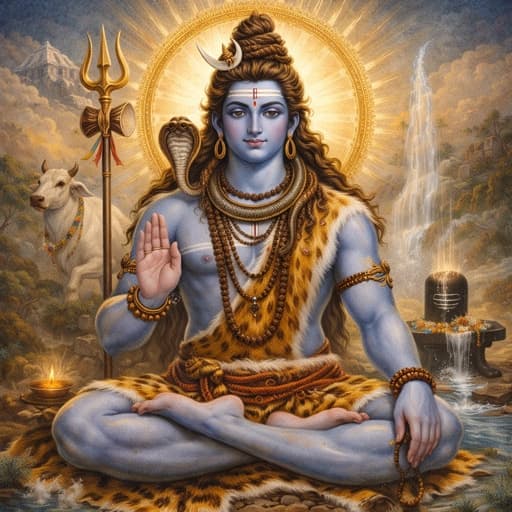
ॐ नमः शिवाय
Om Namah Shivaya
"I bow to Shiva — lord of the five elements, the infinite and all-pervading."
— Vidyeshvara Samhita, Shiva Purana (Panchakshara Mahamantra)
24,000+
Shlokas
7
Samhitas
12
Jyotirlingas
Vyasa
Author
One of the 18 Mahapuranas — the foundational scripture of the Shaiva tradition. The authoritative source for the stories of Sati, Parvati, Ganesha, Kartikeya, and the 12 Jyotirlingas.
The Shiva Purana is one of the 18 Mahapuranas composed by Vedavyasa — 24,000+ shlokas across 7 Samhitas, narrating the glory of Lord Shiva, his stories, and the complete Shaiva philosophy. It is the supreme scriptural authority of the Shaiva tradition, explaining Linga worship, the Panchakshara mantra, the 12 Jyotirlingas, and the Advaita (non-dual) unity of Shiva and Shakti.
Classification
Mahapurana, Shaiva tradition
Samhitas
7 (Vidyeshvara to Vayaviya)
Language
Sanskrit (Puranic)
Presiding deity
Lord Shiva (Sadashiva)
Vidyeshvara to Vayaviya — the complete scope of the Shiva Purana
The immortal narratives of the Shiva Purana — stories that keep the Hindu tradition alive today
Brahma and Vishnu once disputed which of them was the greater god. As their argument intensified, an infinite pillar of blazing fire (Jyotirlinga) erupted between them. Brahma flew upward as a swan to find its top; Vishnu dived downward as a boar to find its base — both failed after aeons of searching. Shiva then revealed himself at the centre: he is the Ananta (infinite), beyond all measure. The 12 places where this pillar touched the earth became the sacred Jyotirlinga shrines.
Sati (Daksha's daughter and Shiva's first wife) attended her father Daksha's yajna (fire ritual) despite being forbidden, as Shiva was not invited — Daksha considered Shiva inferior. Daksha publicly insulted Shiva. Unable to bear her husband's dishonour, Sati immolated herself in the yajna fire. Shiva, consumed by grief and rage, performed the Tandava (cosmic dance of destruction) and carried Sati's body across the universe. Vishnu used his Sudarshana Chakra to cut Sati's body into 51 pieces, which fell across the Indian subcontinent — each becoming a Shakti Peetha, a seat of divine feminine power worshipped to this day.
After Sati's death, Shiva retreated into deep meditation on Mount Kailash. The gods needed Shiva to father a son (Kartikeya) who could slay the demon Tarakasura. Sati was reborn as Parvati, daughter of the Himalayas. To win Shiva's attention, Parvati performed severe tapasya (austerities) for thousands of years — standing on one leg, fasting, meditating in extreme heat and cold. Even the sage Narada and the god Kamadeva (who was burnt to ash by Shiva's third eye) tried to help. Finally, moved by her devotion, Shiva accepted Parvati as his wife — their union represents the reconciliation of asceticism and love.
Parvati, feeling lonely while Shiva was away meditating, created a son from the turmeric paste (ubtan) she used for her bath — breathing life into him as Ganesha. She instructed him to guard her chamber. When Shiva returned and was stopped by Ganesha (who did not know who Shiva was), Shiva in anger severed Ganesha's head. Parvati was distraught. Shiva, to pacify her, sent his ganas (attendants) to bring the head of the first creature they found sleeping facing north — they returned with an elephant's head. Shiva attached the elephant head to Ganesha's body and restored his life, naming him Ganapati (lord of the ganas) — to be worshipped first before all gods.
Tarakasura, the demon king, had obtained a boon that he could only be killed by Shiva's son — thinking Shiva (a celibate ascetic) would never have a child. The gods, tormented by Tarakasura, prayed for Shiva and Parvati to unite. After their cosmic union, Shiva's divine seed (tejas) was too powerful for Parvati to contain — it fell into the river Ganga, then onto the Sharavana reeds, where it was nurtured by the six Krittikas (Pleiades). The child born there was Kartikeya (Skanda / Murugan in Tamil) — born with six heads, one for each Krittika mother. He defeated Tarakasura and became the general of the divine army (Devasena).
The demon Tarakasura's three sons (Tarakaksha, Kamalaksha, Vidyunmali) obtained the boon of three indestructible flying cities (Tripura) made of gold, silver, and iron, which could only be destroyed when all three aligned in a single line. The gods, terrorised for aeons, approached Shiva. He waited for the cosmic alignment, then with a single arrow (fashioned from Vishnu, Brahma, and all the gods as different parts of his bow and chariot) destroyed all three cities simultaneously. The ash of the Tripura demons is said to be the Vibhuti (sacred ash) that Shiva applies on his forehead — symbolising the destruction of the three-fold bondage of ignorance.
Twelve sites across India where the cosmic pillar of Shiva-light (Jyotirlinga) touched the earth — each associated with a specific story and form of Shiva. Somnath (Gujarat) — where the moon regained its lustre after Daksha's curse. Mallikarjuna (Andhra Pradesh) — Kartikeya's requested shrine. Mahakala (Ujjain) — the lord of time and death. Omkareshvara (Madhya Pradesh) — the om-shaped island. Kedarnath (Uttarakhand) — Shiva as the bull. Bhimashankar (Maharashtra) — slayer of Bhimasura. Vishvanatha (Varanasi) — lord of the universe. Tryambakeshvara (Nashik) — three-eyed lord. Vaidyanatha (Deoghar) — the divine physician. Nageshvara (Gujarat) — the serpent lord. Rameshvara (Tamil Nadu) — established by Rama. Grishneshvara (Aurangabad) — the compassionate lord.
India's 12 sacred Shiva shrines — symbols of the eternal Shiva-light
Somnath
Gujarat
Mallikarjuna
Andhra Pradesh
Mahakala
Madhya Pradesh (Ujjain)
Omkareshvara
Madhya Pradesh
Kedarnath
Uttarakhand
Bhimashankar
Maharashtra
Vishvanatha
Varanasi (UP)
Tryambakeshvara
Maharashtra (Nashik)
Vaidyanatha
Jharkhand (Deoghar)
Nageshvara
Gujarat
Rameshvara
Tamil Nadu
Grishneshvara
Maharashtra (Aurangabad)
Four philosophical pillars of the Shiva Purana
Na = Earth (Prithvi), Ma = Water (Jala), Shi = Fire (Agni), Va = Air (Vayu), Ya = Space (Akasha) — the five syllables represent the five elements of creation, with each bowing (Namah) to Shiva who transcends them all.
नमः शिवाय (न-म-शि-व-य)
Na-Ma-Shi-Va-Ya
— Vidyeshvara Samhita, Shiva Purana
The Shivalinga is not a phallic symbol as misunderstood in the West — it is the formless (Nirguna) Brahman represented in a form accessible to worshippers. The circular base (Pitha) represents Shakti; the pillar represents Shiva. Together they symbolise the unity of creation and the infinite nature of consciousness that underlies all existence.
अनादि अनन्त महेश्वर लिंगम्
Anadi Ananta Maheshvara lingam
— Vidyeshvara Samhita, Shiva Purana
Shiva performs five cosmic functions continuously: Srishti (creation), Sthiti (preservation), Samhara (dissolution), Tirobhava (concealment — the veiling of truth by Maya), and Anugraha (grace — the revelation of truth to the seeker). These 5 actions are represented by Shiva Nataraja's dance.
सृष्टि स्थिति संहार तिरोभाव अनुग्रह
Srishti Sthiti Samhara Tirobhava Anugraha
— Kailasa Samhita, Shiva Purana
The Shaiva Siddhanta philosophy in three terms: Pati (Lord/God = Shiva), Pashu (bound soul = individual Jiva), Pasha (bondage = Anava-mala/ego-impurity, Karma-mala, Maya-mala). The goal of Shaiva practice is for Pashu (the soul) to dissolve its Pasha (bondage) and recognise its identity with Pati (Shiva) — from bound soul to liberated Shiva-consciousness.
पतिः पशोः पाशाः बन्धनः
Pati Pashoh Pashavah Pasha Bandhanah
— Vayaviya Samhita, Shiva Purana
Shiva mantras, stotrams, and aarti — explore now
The Shiva Purana is one of the 18 Mahapuranas of Sanatana Dharma, traditionally attributed to Veda Vyasa — about 24,000 shlokas across 7 Samhitas. It narrates the glory, forms, and stories of Lord Shiva and expounds the Shaiva path of devotion and philosophy.
The greatness of Shiva and the Linga, the Panchakshara mantra ("Om Namah Shivaya"), the stories of Sati, Parvati, Ganesha and Kartikeya, the origin of the 12 Jyotirlingas, and the principles of Shaiva worship, meditation, and the unity of Shiva and Shakti.
The 12 Jyotirlingas are the most sacred self-manifested shrines of Shiva across India — from Somnath and Mahakaleshwar to Kashi Vishwanath and Rameshwaram. The Shiva Purana describes their origins and the merit of their darshan.
It is the Panchakshara (five-syllable) maha-mantra of Shiva, meaning "I bow to Shiva." It is the heart of Shaiva devotion and may be chanted by anyone, anytime, for inner purification and peace.
It is read or recited as parayana — especially during the month of Shravan, on Mondays (Somvar), and on Maha Shivaratri. This page summarizes it; for full merit, read or hear the complete text from a qualified source.
Updated for 2026
2026 के लिए अद्यतन
Recently Accessed
Premium Tools
View All →Trending Topics
Explore related Hindu wisdom, daily guidance, and AI-powered answers on VedKosh.
Independently reviewed for authenticity. Please verify meanings and rituals yourself before following. Not medical, legal or financial advice.