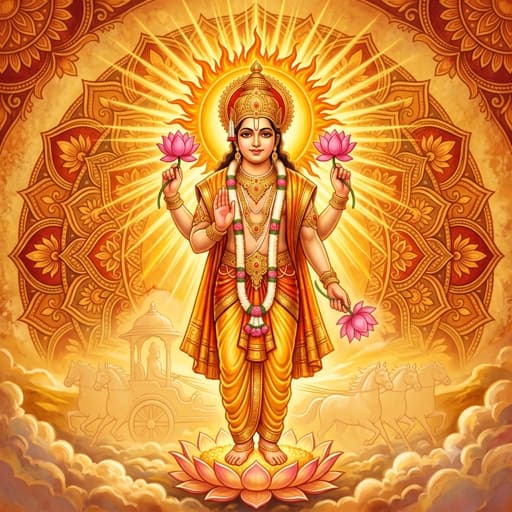
Aditya Hridaya Stotra — Divine Mantra for Victory, Fame and Health
This stotra from Yuddhakanda of Valmiki Ramayana is the supreme praise of the Sun. Sage Agastya gave it to weary Ram on the battlefield — and Ram defeated Ravana.
Aditya Hridayam — Complete Original Text (31 Verses)
tato yuddhapariśrāntaṃ samare cintayā sthitam | rāvaṇaṃ cāgrato dṛṣṭvā yuddhāya samupasthitam ||1||

daivataiśca samāgamya draṣṭumabhyāgato raṇam | upāgamyābravīdrāmamagastyo bhagavānṛṣiḥ ||2||

rāma rāma mahābāho śṛṇu guhyaṃ sanātanam | yena sarvānarīnvatsa samare vijayiṣyasi ||3||

ādityahṛdayaṃ puṇyaṃ sarvaśatruvināśanam | jayāvahaṃ japennityamakṣayyaṃ paramaṃ śivam ||4||

sarvamaṅgalamāṅgalyaṃ sarvapāpapraṇāśanam | cintāśokapraśamanamāyurvardhanamuttamam ||5||

raśmimantaṃ samudyantaṃ devāsuranamaskṛtam | pūjayasva vivasvantaṃ bhāskaraṃ bhuvaneśvaram ||6||

sarvadevātmako hyeṣaḥ tejasvī raśmibhāvanaḥ | eṣa devāsuragaṇān lokān pāti gabhastibhiḥ ||7||

eṣa brahmā ca viṣṇuśca śivaḥ skandaḥ prajāpatiḥ | māhendro dhanadaḥ kālo yamassomo hyapāṃ patiḥ ||8||

pitaro vasavassādhyāḥ hyaśvinau maruto manuḥ | vāyurvahniḥ prajāprāṇā ṛtukartā prabhākaraḥ ||9||

ādityaḥ savitā sūryaḥ khagaḥ pūṣā gabhastimān | suvarṇasadṛśo bhānurhiraṇyareto divākaraḥ ||10||

haridaśvassahasrārcissaptasaptirmarīcimān | timironmathanaśśambhustvaṣṭā mārtāṇḍa aṃśumān ||11||

hiraṇyagarbhaśśiśirastapano bhāskaro raviḥ | agnigarbho'diteḥ putraḥ śaṅkhaśśiśiranāśanaḥ ||12||

vyomanāthastamobhedī ṛgyajussāmapāragaḥ | ghanavṛṣṭirapāṃ mitro vindhyavīthīplavaṅgamaḥ ||13||

ātapī maṇḍalī mṛtyuḥ piṅgalassarvatāpanaḥ | kavirviśvo mahātejāḥ raktassarvabhavodbhavaḥ ||14||

nakṣatragrahatārāṇāmadhipo viśvabhāvanaḥ | tejasāmapi tejasvī dvādaśātmannamo'stu te ||15||

namaḥ pūrvāya giraye paścimāyādraye namaḥ | jyotirgaṇānāṃ pataye dinādhipataye namaḥ ||16||

jayāya jayabhadrāya haryaśvāya namo namaḥ | namo namassahasrāṃśo ādityāya namo namaḥ ||17||

nama ugrāya vīrāya sāraṅgāya namo namaḥ | namaḥ padmaprabodhāya mārtaṇḍāya namo namaḥ ||18||

brahmeśānācyuteśāya sūryādityavarcase | bhāsvate sarvabhakṣāya raudrāya vapuṣe namaḥ ||19||

tamoghnāya himaghnāya śatrughnāyāmitātmane | kṛtaghnaghnāya devāya jyotiṣāṃ pataye namaḥ ||20||

taptacāmīkarābhāya vahnaye viśvakarmaṇe | namastamo'bhinighnāya rucaye lokasākṣiṇe ||21||

nāśayatyeṣa vai bhūtaṃ tadeva sṛjati prabhuḥ | pāyatyeṣa tapatyeṣa varṣatyeṣa gabhastibhiḥ ||22||

eṣa supteṣu jāgarti bhūteṣu pariniṣṭhitaḥ | eṣa caivāgnihotraṃ ca phalaṃ caivāgnihotriṇām ||23||

vedāśca kratavaścaiva kratūnāṃ phalameva ca | yāni kṛtyāni lokeṣu sarva eṣa raviḥ prabhuḥ ||24||

enamāpatsu kṛcchreṣu kāntāreṣu bhayeṣu ca | kīrtayan puruṣaḥ kaścinnāvasīdati rāghava ||25||

pūjayasvainamekāgro devadevaṃ jagatpatim | etattriguṇitaṃ japtvā yuddheṣu vijayiṣyasi ||26||

asmin kṣaṇe mahābāho rāvaṇaṃ tvaṃ vadhiṣyasi | evamuktvā tato'gastyo jagāma ca yathāgatam ||27||

etacchrutvā mahātejāḥ naṣṭaśoko'bhavattadā | dhārayāmāsa suprīto rāghavaḥ prayatātmavān ||28||

ādityaṃ prekṣya japtvā tu paraṃ harṣamavāptavān | trirācamya śucirbhūtvā dhanurādāya vīryavān ||29||

rāvaṇaṃ prekṣya hṛṣṭātmā yuddhāya samupāgamat | sarvayatnena mahatā vadhe tasya dhṛto'bhavat ||30||

atha raviravadannirīkṣya rāmaṃ muditamanāḥ paramaṃ prahṛṣyamāṇaḥ | niśicarapatisaṃkṣayaṃ viditvā suragaṇamadhyagato vacastvareti ||31||
Verse-by-Verse Meaning
Tap “Show meaning” under any verse to read its meaning.
ततो युद्धपरिश्रान्तं समरे चिन्तया स्थितम् । रावणं चाग्रतो दृष्ट्वा युद्धाय समुपस्थितम् ॥१॥
tato yuddhapariśrāntaṃ samare cintayā sthitam | rāvaṇaṃ cāgrato dṛṣṭvā yuddhāya samupasthitam ||1||
Show meaningHide meaning
Weary from the long battle and lost in thought, Rama stood on the battlefield when he saw Ravana once again standing ready before him for combat.
दैवतैश्च समागम्य द्रष्टुमभ्यागतो रणम् । उपागम्याब्रवीद्राममगस्त्यो भगवानृषिः ॥२॥
daivataiśca samāgamya draṣṭumabhyāgato raṇam | upāgamyābravīdrāmamagastyo bhagavānṛṣiḥ ||2||
Show meaningHide meaning
At that moment, the venerable sage Agastya, who had come along with the gods to witness the war, approached Rama and spoke to him.
राम राम महाबाहो शृणु गुह्यं सनातनम् । येन सर्वानरीन्वत्स समरे विजयिष्यसि ॥३॥
rāma rāma mahābāho śṛṇu guhyaṃ sanātanam | yena sarvānarīnvatsa samare vijayiṣyasi ||3||
Show meaningHide meaning
"O Rama, O mighty-armed one! Listen to this eternal, secret teaching, by which, dear child, you shall conquer all your enemies in battle."
आदित्यहृदयं पुण्यं सर्वशत्रुविनाशनम् । जयावहं जपेन्नित्यमक्षय्यं परमं शिवम् ॥४॥
ādityahṛdayaṃ puṇyaṃ sarvaśatruvināśanam | jayāvahaṃ japennityamakṣayyaṃ paramaṃ śivam ||4||
Show meaningHide meaning
This Aditya Hridaya is sacred and destroys all enemies; it brings victory, is inexhaustible in its power, and is supremely auspicious — it should be recited every day.
सर्वमङ्गलमाङ्गल्यं सर्वपापप्रणाशनम् । चिन्ताशोकप्रशमनमायुर्वर्धनमुत्तमम् ॥५॥
sarvamaṅgalamāṅgalyaṃ sarvapāpapraṇāśanam | cintāśokapraśamanamāyurvardhanamuttamam ||5||
Show meaningHide meaning
It is the most auspicious among all auspicious things, it destroys every sin, calms anxiety and grief, and is the supreme means of extending one's life.
रश्मिमन्तं समुद्यन्तं देवासुरनमस्कृतम् । पूजयस्व विवस्वन्तं भास्करं भुवनेश्वरम् ॥६॥
raśmimantaṃ samudyantaṃ devāsuranamaskṛtam | pūjayasva vivasvantaṃ bhāskaraṃ bhuvaneśvaram ||6||
Show meaningHide meaning
Worship the radiant, rising Sun — the illuminator Bhaskara, lord of all the worlds — who is saluted alike by gods and demons.
सर्वदेवात्मको ह्येषः तेजस्वी रश्मिभावनः । एष देवासुरगणान् लोकान् पाति गभस्तिभिः ॥७॥
sarvadevātmako hyeṣaḥ tejasvī raśmibhāvanaḥ | eṣa devāsuragaṇān lokān pāti gabhastibhiḥ ||7||
Show meaningHide meaning
He is the very essence of all the gods, full of brilliance and the source of light; with his rays he protects and sustains the worlds of gods and demons alike.
एष ब्रह्मा च विष्णुश्च शिवः स्कन्दः प्रजापतिः । माहेन्द्रो धनदः कालो यमस्सोमो ह्यपां पतिः ॥८॥
eṣa brahmā ca viṣṇuśca śivaḥ skandaḥ prajāpatiḥ | māhendro dhanadaḥ kālo yamassomo hyapāṃ patiḥ ||8||
Show meaningHide meaning
He himself is Brahma, Vishnu, Shiva, Skanda and Prajapati; he is also Indra, the lord of wealth, Time, Yama, Soma, and the lord of the waters.
पितरो वसवस्साध्याः ह्यश्विनौ मरुतो मनुः । वायुर्वह्निः प्रजाप्राणा ऋतुकर्ता प्रभाकरः ॥९॥
pitaro vasavassādhyāḥ hyaśvinau maruto manuḥ | vāyurvahniḥ prajāprāṇā ṛtukartā prabhākaraḥ ||9||
Show meaningHide meaning
He is the ancestral spirits, the Vasus, the Sadhyas, the two Ashvin gods, the wind-gods and Manu; he is Vayu, Agni, the very life-breath of all beings, the maker of the seasons and the giver of light.
आदित्यः सविता सूर्यः खगः पूषा गभस्तिमान् । सुवर्णसदृशो भानुर्हिरण्यरेतो दिवाकरः ॥१०॥
ādityaḥ savitā sūryaḥ khagaḥ pūṣā gabhastimān | suvarṇasadṛśo bhānurhiraṇyareto divākaraḥ ||10||
Show meaningHide meaning
He is known by many names — Aditya, Savita, Surya, the sky-mover, Pusha, the possessor of rays; golden in hue, radiant, the source of gold, and the maker of the day.
हरिदश्वस्सहस्रार्चिस्सप्तसप्तिर्मरीचिमान् । तिमिरोन्मथनश्शम्भुस्त्वष्टा मार्ताण्ड अंशुमान् ॥११॥
haridaśvassahasrārcissaptasaptirmarīcimān | timironmathanaśśambhustvaṣṭā mārtāṇḍa aṃśumān ||11||
Show meaningHide meaning
He drives tawny horses, bears a thousand rays, rides a chariot of seven steeds and is full of light; he is the destroyer of darkness, Shambhu, Tvashta, Martanda, the possessor of rays.
हिरण्यगर्भश्शिशिरस्तपनो भास्करो रविः । अग्निगर्भोऽदितेः पुत्रः शङ्खश्शिशिरनाशनः ॥१२॥
hiraṇyagarbhaśśiśirastapano bhāskaro raviḥ | agnigarbho'diteḥ putraḥ śaṅkhaśśiśiranāśanaḥ ||12||
Show meaningHide meaning
He is called Hiranyagarbha, the one who both cools and warms, the illuminator, Ravi; he holds fire within him, is the son of Aditi, conch-shaped, and the destroyer of cold.
व्योमनाथस्तमोभेदी ऋग्यजुस्सामपारगः । घनवृष्टिरपां मित्रो विन्ध्यवीथीप्लवङ्गमः ॥१३॥
vyomanāthastamobhedī ṛgyajussāmapāragaḥ | ghanavṛṣṭirapāṃ mitro vindhyavīthīplavaṅgamaḥ ||13||
Show meaningHide meaning
He is the lord of the sky, the piercer of darkness, master of the Rig, Yajur and Sama Vedas; he brings the dense rains, is a friend of the waters, and traverses the passes of the Vindhya range.
आतपी मण्डली मृत्युः पिङ्गलस्सर्वतापनः । कविर्विश्वो महातेजाः रक्तस्सर्वभवोद्भवः ॥१४॥
ātapī maṇḍalī mṛtyuḥ piṅgalassarvatāpanaḥ | kavirviśvo mahātejāḥ raktassarvabhavodbhavaḥ ||14||
Show meaningHide meaning
He is scorching heat itself, circular in form, he is Death itself, the one who heats all beings, tawny in colour; he is all-knowing, the very universe in form, of great splendour, and the reddish source from which all creation arises.
नक्षत्रग्रहताराणामधिपो विश्वभावनः । तेजसामपि तेजस्वी द्वादशात्मन्नमोऽस्तु ते ॥१५॥
nakṣatragrahatārāṇāmadhipo viśvabhāvanaḥ | tejasāmapi tejasvī dvādaśātmannamo'stu te ||15||
Show meaningHide meaning
He is the lord of the constellations, planets and stars, and the creator of the entire universe; the most radiant even among the radiant — O twelve-formed one, salutations to you.
नमः पूर्वाय गिरये पश्चिमायाद्रये नमः । ज्योतिर्गणानां पतये दिनाधिपतये नमः ॥१६॥
namaḥ pūrvāya giraye paścimāyādraye namaḥ | jyotirgaṇānāṃ pataye dinādhipataye namaḥ ||16||
Show meaningHide meaning
Salutations to the eastern mountain over which he rises, salutations to the western mountain over which he sets; salutations to the lord of all luminous bodies, the ruler of the day.
जयाय जयभद्राय हर्यश्वाय नमो नमः । नमो नमस्सहस्रांशो आदित्याय नमो नमः ॥१७॥
jayāya jayabhadrāya haryaśvāya namo namaḥ | namo namassahasrāṃśo ādityāya namo namaḥ ||17||
Show meaningHide meaning
Salutations again and again to Victory itself, to the giver of auspicious victory, to him who rides tawny horses; salutations again and again to the thousand-rayed Aditya.
नम उग्राय वीराय सारङ्गाय नमो नमः । नमः पद्मप्रबोधाय मार्तण्डाय नमो नमः ॥१८॥
nama ugrāya vīrāya sāraṅgāya namo namaḥ | namaḥ padmaprabodhāya mārtaṇḍāya namo namaḥ ||18||
Show meaningHide meaning
Salutations to the fierce, heroic one, to the swift-moving Sun; salutations to him who causes the lotuses to bloom, salutations to Martanda.
ब्रह्मेशानाच्युतेशाय सूर्यादित्यवर्चसे । भास्वते सर्वभक्षाय रौद्राय वपुषे नमः ॥१९॥
brahmeśānācyuteśāya sūryādityavarcase | bhāsvate sarvabhakṣāya raudrāya vapuṣe namaḥ ||19||
Show meaningHide meaning
Salutations to him who is present as Brahma, Ishana and Achyuta, whose splendour is that of Surya and Aditya; to the radiant one who, in his fierce form, consumes/devours all.
तमोघ्नाय हिमघ्नाय शत्रुघ्नायामितात्मने । कृतघ्नघ्नाय देवाय ज्योतिषां पतये नमः ॥२०॥
tamoghnāya himaghnāya śatrughnāyāmitātmane | kṛtaghnaghnāya devāya jyotiṣāṃ pataye namaḥ ||20||
Show meaningHide meaning
Salutations to the destroyer of darkness, the destroyer of cold, the destroyer of enemies, the one of boundless nature; to the god who destroys ingratitude, the lord of all luminaries.
तप्तचामीकराभाय वह्नये विश्वकर्मणे । नमस्तमोऽभिनिघ्नाय रुचये लोकसाक्षिणे ॥२१॥
taptacāmīkarābhāya vahnaye viśvakarmaṇe | namastamo'bhinighnāya rucaye lokasākṣiṇe ||21||
Show meaningHide meaning
Salutations to him whose glow is like molten gold, who is Fire itself, who is the architect and maker of the universe; salutations to the destroyer of darkness, the luminous one, the witness of all the worlds.
नाशयत्येष वै भूतं तदेव सृजति प्रभुः । पायत्येष तपत्येष वर्षत्येष गभस्तिभिः ॥२२॥
nāśayatyeṣa vai bhūtaṃ tadeva sṛjati prabhuḥ | pāyatyeṣa tapatyeṣa varṣatyeṣa gabhastibhiḥ ||22||
Show meaningHide meaning
This same Lord both destroys beings and creates them anew; with his rays he nourishes with moisture, scorches with heat, and sends down the rain.
एष सुप्तेषु जागर्ति भूतेषु परिनिष्ठितः । एष चैवाग्निहोत्रं च फलं चैवाग्निहोत्रिणाम् ॥२३॥
eṣa supteṣu jāgarti bhūteṣu pariniṣṭhitaḥ | eṣa caivāgnihotraṃ ca phalaṃ caivāgnihotriṇām ||23||
Show meaningHide meaning
He remains awake even within beings that are asleep, dwelling firmly established in them; he himself is the fire-offering, and he himself is the fruit received by those who perform it.
वेदाश्च क्रतवश्चैव क्रतूनां फलमेव च । यानि कृत्यानि लोकेषु सर्व एष रविः प्रभुः ॥२४॥
vedāśca kratavaścaiva kratūnāṃ phalameva ca | yāni kṛtyāni lokeṣu sarva eṣa raviḥ prabhuḥ ||24||
Show meaningHide meaning
He is the Vedas, he is the sacrifices, and he is the very fruit of those sacrifices; whatever actions take place in the worlds, this Sun alone is the lord governing all of them.
एनमापत्सु कृच्छ्रेषु कान्तारेषु भयेषु च । कीर्तयन् पुरुषः कश्चिन्नावसीदति राघव ॥२५॥
enamāpatsu kṛcchreṣu kāntāreṣu bhayeṣu ca | kīrtayan puruṣaḥ kaścinnāvasīdati rāghava ||25||
Show meaningHide meaning
O Raghava, whoever glorifies him in times of calamity, hardship, in wild forests, or in fear, never sinks into despair.
पूजयस्वैनमेकाग्रो देवदेवं जगत्पतिम् । एतत्त्रिगुणितं जप्त्वा युद्धेषु विजयिष्यसि ॥२६॥
pūjayasvainamekāgro devadevaṃ jagatpatim | etattriguṇitaṃ japtvā yuddheṣu vijayiṣyasi ||26||
Show meaningHide meaning
Worship him with single-pointed devotion — the god of gods, the lord of the universe; having recited this hymn three times over, you shall be victorious in battle.
अस्मिन् क्षणे महाबाहो रावणं त्वं वधिष्यसि । एवमुक्त्वा ततोऽगस्त्यो जगाम च यथागतम् ॥२७॥
asmin kṣaṇe mahābāho rāvaṇaṃ tvaṃ vadhiṣyasi | evamuktvā tato'gastyo jagāma ca yathāgatam ||27||
Show meaningHide meaning
"O mighty-armed one, this very moment you shall slay Ravana." Having spoken thus, Agastya then departed just as he had come.
एतच्छ्रुत्वा महातेजाः नष्टशोकोऽभवत्तदा । धारयामास सुप्रीतो राघवः प्रयतात्मवान् ॥२८॥
etacchrutvā mahātejāḥ naṣṭaśoko'bhavattadā | dhārayāmāsa suprīto rāghavaḥ prayatātmavān ||28||
Show meaningHide meaning
Hearing this, the grief of the greatly radiant Raghava vanished at once; the joyful, self-composed Rama held this teaching firmly in his heart.
आदित्यं प्रेक्ष्य जप्त्वा तु परं हर्षमवाप्तवान् । त्रिराचम्य शुचिर्भूत्वा धनुरादाय वीर्यवान् ॥२९॥
ādityaṃ prekṣya japtvā tu paraṃ harṣamavāptavān | trirācamya śucirbhūtvā dhanurādāya vīryavān ||29||
Show meaningHide meaning
Gazing upon the Sun and reciting this hymn, Rama attained supreme joy; sipping water three times for purification, the valiant one took up his bow.
रावणं प्रेक्ष्य हृष्टात्मा युद्धाय समुपागमत् । सर्वयत्नेन महता वधे तस्य धृतोऽभवत् ॥३०॥
rāvaṇaṃ prekṣya hṛṣṭātmā yuddhāya samupāgamat | sarvayatnena mahatā vadhe tasya dhṛto'bhavat ||30||
Show meaningHide meaning
Beholding Ravana, Rama advanced to battle with a joyful heart; with all his strength and effort he was firmly resolved on Ravana's destruction.
अथ रविरवदन्निरीक्ष्य रामं मुदितमनाः परमं प्रहृष्यमाणः । निशिचरपतिसंक्षयं विदित्वा सुरगणमध्यगतो वचस्त्वरेति ॥३१॥
atha raviravadannirīkṣya rāmaṃ muditamanāḥ paramaṃ prahṛṣyamāṇaḥ | niśicarapatisaṃkṣayaṃ viditvā suragaṇamadhyagato vacastvareti ||31||
Show meaningHide meaning
Then the Sun, gazing upon Rama with a joyful and deeply delighted heart, and knowing that the destruction of the lord of the night-wanderers (Ravana) was now at hand, spoke these words swiftly, amid the assembly of the gods.
4 Key Benefits of Aditya Hridayam
Recitation Method — For Sunday
Aditya Hridayam Recitation Checklist
0/5- On Sunday, recite at sunrise facing the Sun directionSitting on an asana, facing east
- Recite 3 times — as Ram recited 3 times on the battlefield
- In difficult times, recite 11 timesBefore court, exam or competition
- After recitation, offer Arghya with copper vessel
- Recite daily for 30 days — receive complete fruit
Frequently Asked Questions
What is the Aditya Hridaya Stotra?
The Aditya Hridaya Stotra is a sacred Hindu devotional hymn (stotram) dedicated to Surya. VedKosh provides its complete text in Hindi and English with transliteration for regional readers.
What are the benefits of reciting the Aditya Hridaya Stotra?
Reciting the Aditya Hridaya Stotra with devotion is traditionally believed to invoke the grace of Surya, calm and focus the mind, and create an auspicious, sattvic atmosphere. It is practised as an act of bhakti (devotion) rather than for any guaranteed material outcome.
When should the Aditya Hridaya Stotra be recited?
The Aditya Hridaya Stotra can be recited during daily morning or evening worship of Surya, and especially on the deity's sacred days and festivals. A clean, quiet space and a steady, devotional mind are the main requirements.
अक्सर पूछे जाने वाले प्रश्न
Aditya Hridaya Stotra क्या है?
Aditya Hridaya Stotra सूर्य को समर्पित एक पवित्र हिन्दू भक्ति स्तोत्र है। वेदकोश पर इसका पूर्ण पाठ हिंदी और अंग्रेज़ी में (क्षेत्रीय पाठकों हेतु लिप्यंतरण सहित) उपलब्ध है।
Aditya Hridaya Stotra के पाठ के क्या लाभ माने जाते हैं?
Aditya Hridaya Stotra का श्रद्धापूर्वक पाठ सूर्य की कृपा का आह्वान करता है, मन को शांत व एकाग्र करता है और शुभ, सात्विक वातावरण बनाता है। इसे किसी निश्चित भौतिक फल की गारंटी के रूप में नहीं, बल्कि भक्ति-भाव से किया जाता है।
Aditya Hridaya Stotra का पाठ कब करना चाहिए?
Aditya Hridaya Stotra का पाठ सूर्य की प्रातः या संध्या पूजा में, तथा विशेषकर देवता के पवित्र दिनों व पर्वों पर किया जा सकता है। स्वच्छ, शांत स्थान और स्थिर भक्ति-भाव ही मुख्य आवश्यकता है।
Updated for 2026
2026 के लिए अद्यतन